Most commercial roofs are ignored until water finds its way onto stock, machinery or a ceiling. By then the choice is already narrow, because the work has to happen now, on whatever budget exists. A condition survey changes that order of events. It looks at the roof while it is still working, records what is wearing out and sets a sensible sequence of repairs, so a landlord, tenant or facilities manager can plan spending instead of reacting.
The survey has more than one job. It supports a repair or re-roof decision, it feeds into a lease event such as a renewal or an exit, and it gives a buyer or a lender a clear record of an asset that is rarely seen. This guide explains what a surveyor looks at, how drones and core samples fit in, what a good report contains, and how to commission one so the answers are useful when you need to act on them.
What a condition survey sets out to answer
A condition survey is a structured look at the whole roof, not a hunt for one leak. It answers a handful of plain questions: what is the roof made of, what condition is each part in, what is likely to fail first, and what does it need now, soon and later.
How is it different from a leak call-out?
A call-out chases a symptom. Someone finds the wet patch, traces it, patches it and leaves. A survey steps back from the symptom and treats the leak as one data point among many. It may find that the leak came from a failed lap while a dozen similar laps are close behind it, or that the roof is fine and the problem is a blocked outlet. That wider view is what lets you decide whether to keep repairing or to budget for something bigger.
What does it cover?
The surveyor records the roof type, access arrangements, drainage, rooflights, plant and cabling, upstands, parapets, edge details and the condition of the covering itself. They note previous repairs and whether they were done well. They also look from inside where they can, since a brown ring on a ceiling tile or a tide mark low on a wall is evidence about where water travels. Interior marks rarely sit directly under the failure, so the surveyor works backwards from them along the line of the deck, the rafters or the purlins until the likely entry point is found.
The result should be a record you can act on, not a general opinion. Our commercial roofing page lists the roof types we survey and work on.
On the roof: what the surveyor checks
The walk-over is the heart of the survey, and it begins before anyone sets foot on the roof. Access is planned, edge protection is considered, and fragile areas are identified first. Our guide to fragile roofs and rooflights explains why that planning matters.
Single-ply, felt and built-up roofs
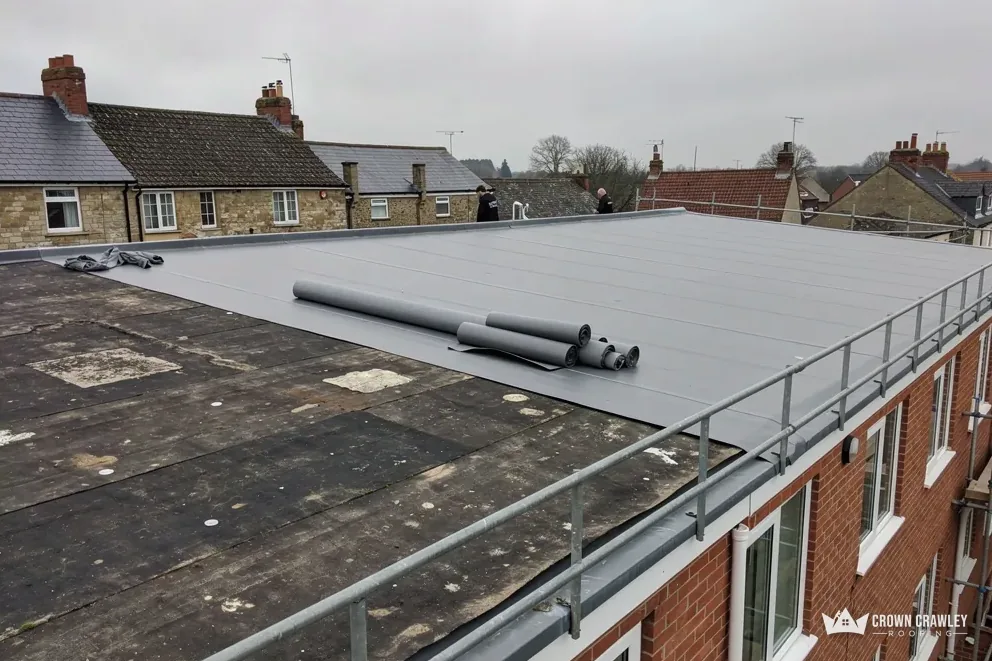
On a membrane roof the surveyor looks at seams and laps, blisters, splits, wrinkles, loss of surface protection and the condition of flashings where the membrane turns up a wall. They check outlets and gullies for blockages and signs of ponding, meaning water that stays on the surface instead of draining away. Standing water is not always a defect, but it is always worth recording because it tells you about falls and about how the covering is ageing.
Metal and profiled sheeting
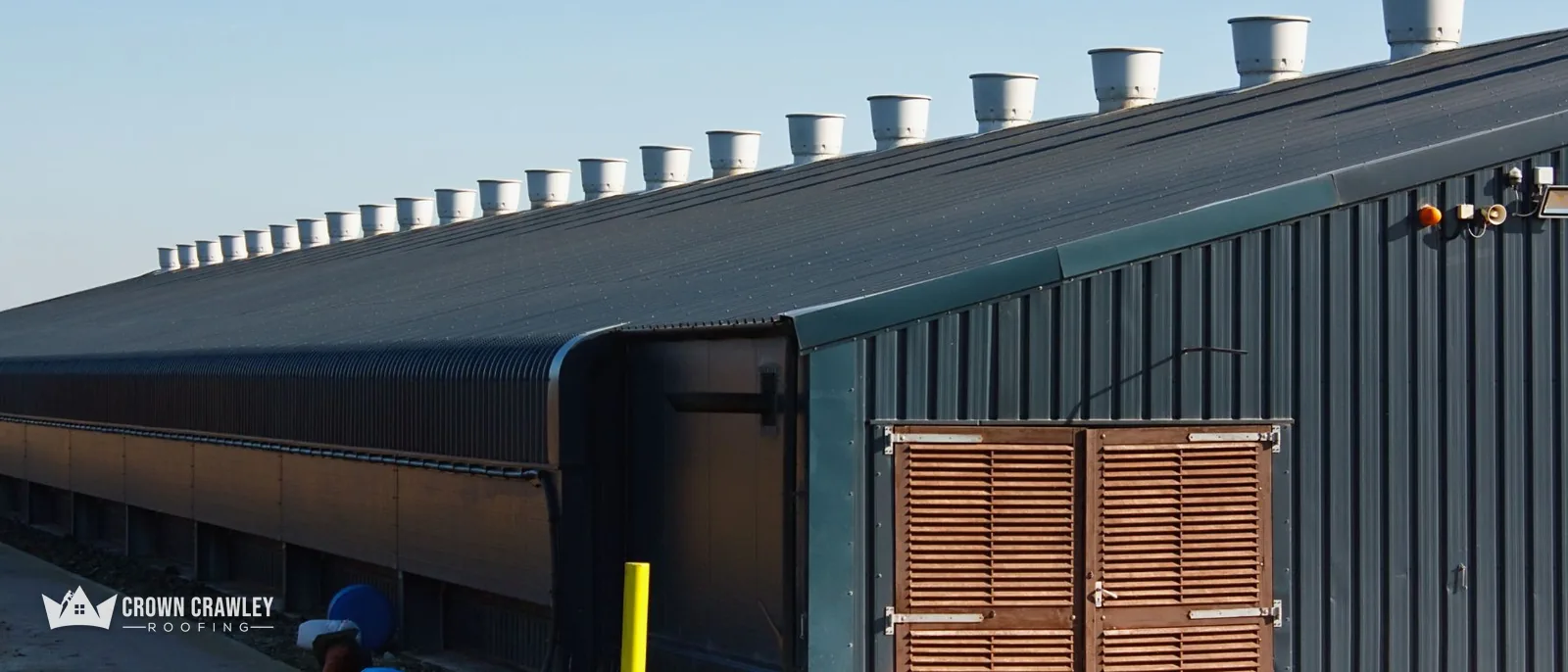
On sheeted roofs the focus moves to fixings, laps, sealant, rust at cut edges, damaged coating and distorted sheets. Rooflights get their own attention, because they are often the weakest point in strength and in weather resistance. Gutters between sheets and parapet linings come next, since they carry a lot of water and are tricky to repair. For a closer look at one common metal defect, see our guide to cut edge corrosion.
What about asbestos cement?
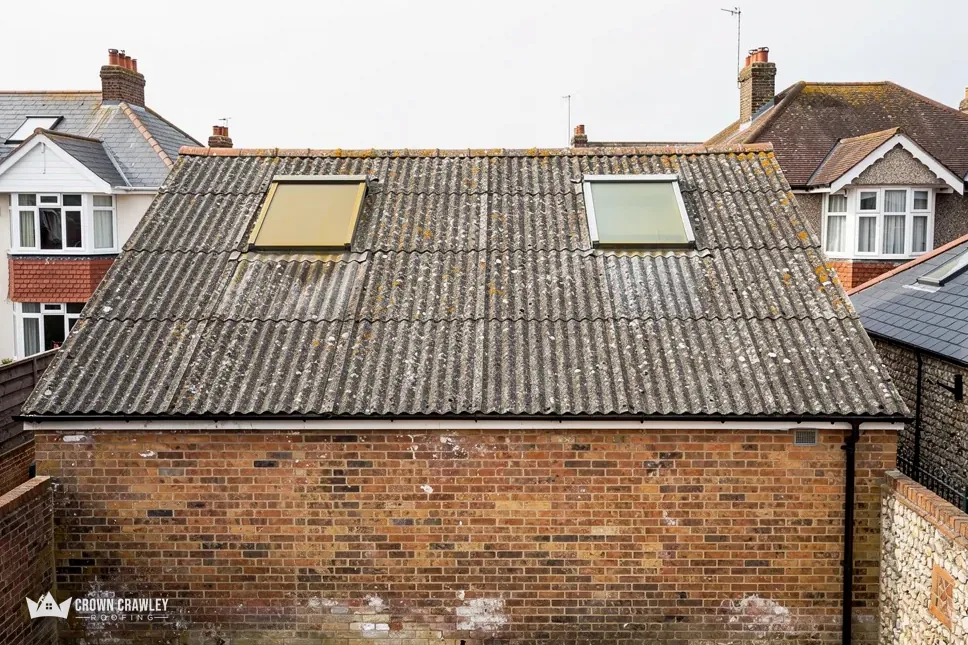
HSE advises presuming asbestos in any building from before 2000, and describes asbestos cement roofing as fragile in every case. That presumption shapes the whole visit, from who is allowed on the roof to which tools are used. A surveyor who finds such sheets should say so, stop short of disturbing them and recommend proper identification before any work.
Drones and thermal imaging
Drones have changed how roofs are surveyed, mainly by removing the need to walk on delicate or hard-to-reach areas. They suit large roofs, steep or fragile ones, and roofs where access would need scaffold or a platform just to look.
What can a drone capture?
A drone gives overhead images of the full roof, so the surveyor can see patterns that are invisible at ground level: ponding stains, lines of failed laps, areas of moss or debris, displaced sheets, damaged flashings and the layout of plant. Close-up shots can be taken of a specific detail without anyone standing beside it. The images become a visual record you can compare against the next survey.
Where do drones fall short?
A picture cannot tell you whether a sheet is brittle, whether insulation below a membrane is wet or whether a seam has fused properly. Drones also depend on weather and permissions. Near Gatwick, the airport says that using a drone within 5km of it is restricted, so the pilot must check the rules before flying. A drone survey is often followed by hands-on checks at the points it flags.
Where does thermal imaging fit?
Thermal cameras can show temperature differences that hint at trapped moisture beneath a flat roof covering. The reading is a clue, not proof, and it is usually confirmed with a probe or a sample. When we survey, we send you pictures taken on your roof, so what we saw is there for you to see too and not only a summary of it.
Core samples and the build-up beneath
The visible surface of a flat roof tells you about the top layer only. The condition of the insulation and the deck beneath decides whether the roof can be repaired or has to be replaced, and the only way to know for certain is to open it up.
What is a core sample?
A core is a small circular cut taken through the roof layers, usually at a few chosen spots. It reveals how many layers there are, what each is made of, how thick the insulation is, whether the layers are wet and whether the deck is sound. It is also the best evidence of whether a new waterproof layer can go over the old one or whether the old build-up has to be removed.
How are the holes made good?
Each core hole is a new opening in the waterproofing, so it must be sealed straight away with a compatible repair. Ask who does that and what they use. Any sampling should be done on a dry day, and the survey should record the exact locations so that they can be checked later. Spots are chosen from the walk-over and any thermal clues, not at random, so the surveyor may place several near a suspect outlet.
What does a core change?
It can show that insulation is saturated and the roof is beyond patching, or that the layers are sound and a coating or overlay will do. That difference can be large in cost, and our page on coating or replacement goes into how the choice is made.
What a useful report contains
A report is the product of the survey. If it does not tell you what to do, in what order and why, it has not done its job.
Which parts do you need?
Look for a description of the roof and its build-up, a plan or diagram marking the areas covered, numbered photographs tied to that plan, a defect list with a clear rating for each item and a note of anything that could not be inspected. Each defect should say what was seen, where, what might cause it and what is recommended. Vague lines such as general wear are not much use when you are trying to decide what to fix.
How should repairs be ranked?
Good reports sort the work by urgency: items that need attention now to stop water entering, items to do within a planned period, and items to monitor. That ranking is what turns a document into a maintenance plan. It also gives you a base for comparing quotes, since every contractor can price the same list. You get our price as one written figure when the survey is complete, so it lines up with the list you were handed.
What about costs and lifespan?
Reports often give an estimate of remaining life and a budget figure for repair or replacement. Ask how the surveyor arrived at them. A figure built from your own roof is far more reliable than a rule of thumb, because build-ups, access and condition vary so widely between commercial buildings. Remember to ask whether VAT, at the standard rate of 20%, is included in any budget figure.
Surveys for landlords, tenants and lease events
Roofs sit in the awkward middle of many commercial leases. The landlord usually owns the structure, the tenant often pays for upkeep through a service charge or repairing clause, and nobody looks at the roof until a dispute arrives. A dated survey with photos sets a baseline everyone can refer to.
Why survey at the start of a lease?
A tenant taking on a unit can use a survey to record the roof's condition on day one, which is a fair starting point if a future argument turns on whether a defect was already there. A landlord can use the same record to show what was handed over. Neither party should treat it as legal advice on the lease, so take that from a solicitor.
Why survey before the end of a lease?
Near the end of a term, a landlord may raise a schedule of repairs, and a tenant may want to know what the roof will cost before agreeing to anything. A survey separates ordinary wear from damage and helps put a figure on the work. Our page on roof dilapidations claims covers how those disputes tend to run.
What about a sale or a refinance?
Buyers and lenders ask about roof condition because a failing roof is a large and sudden cost. A recent survey answers the question and shortens the conversation. It also helps to know who pays for what, which is explained in who pays for commercial roof repairs. Send us the lease clause on repairs and any earlier report, and we will begin the survey knowing what question it has to answer.
Part of our Commercial Roofing in Crawley & Gatwick
Survey queries
How long does a commercial roof survey take on site?
That depends on the roof area, access and whether drone work, thermal checks or core samples are included. A small shop roof can be walked quickly, while a large industrial unit needs planned access and more time. The report follows after the visit, so ask for a date when you book.
Can a survey be done while the building is in use?
Usually yes. Most inspection takes place outside, so staff and customers carry on as normal. Interior checks of ceilings and roof voids may need access to certain rooms, and core sampling creates temporary openings that have to be sealed. Tell the surveyor about sensitive areas, such as cold stores, server rooms or production lines.
Is a survey needed before a re-roof quote?
It is the sensible first step, because a quote written without knowing the build-up or the deck is a guess. A survey shows whether the roof can be repaired, coated or overlaid, or whether it must be stripped. That keeps the written price tied to what is actually on your roof.