Ask a homeowner what is on top of their house and they can usually say: tiles, probably. Ask the manager of a commercial building and the answer is often a shrug. The roof is somebody else's problem until a bucket appears on the shop floor. Then it becomes everybody's problem at once, because water on stock, wiring or paperwork costs money before the roofer has even arrived.
Commercial roofs are not simply bigger domestic roofs. They span wider gaps, carry plant and walkways, drain through box gutters and outlets that nobody inspects, and sit above people who cannot simply move out for a week. The building type decides most of the answers, so this post goes through four of them in turn: industrial units, shops, offices and schools. Each gets its usual weak points, the questions worth asking and the point where a repair stops being sensible, and our commercial roofing page covers the wider service. Where a figure or a rule matters, it comes from a published source, and where the answer depends on your roof, it depends on the survey.
Why a commercial roof is a different job
The first difference is scale. A unit on an industrial estate may have a roof area bigger than a street of houses, laid on steel purlins spanning several metres between supports. Nobody walks that surface regularly, so small faults stay hidden for a long time. By the time a stain shows on the ceiling tiles, the water may have travelled along a rail for several metres from where it came in.
What does the covering tell you?
Most low-pitched commercial roofs are one of three families. Metal profiled cladding, laid as one skin or as a layered insulated panel, is common on units and sheds. Single-ply membranes such as EPDM, and built-up bitumen felt, are found on flat roofs over shops and offices. Older buildings may still carry cement sheets, and that brings a rule of its own, covered below. GreenSpec expects EPDM to serve for 20 to 30 years, while Less puts felt at 10 to 20 years. Those are typical published ranges, never promises, and a roof that has been looked after tends to beat them.
Who decides how the work is done?
The answer depends on who owns and who occupies. A tenant may be responsible for repairs while the landlord arranges replacement, or the other way round, and the lease says which. Check it before ordering anything, because a repair booked by the wrong party can end in an argument over who pays. Our answer on who pays for commercial roof repairs goes through the usual patterns. Whatever the lease says, the starting point is the same: a survey of the roof as it is, with photographs, before anyone talks about a price.
Industrial units: big spans and hidden damage
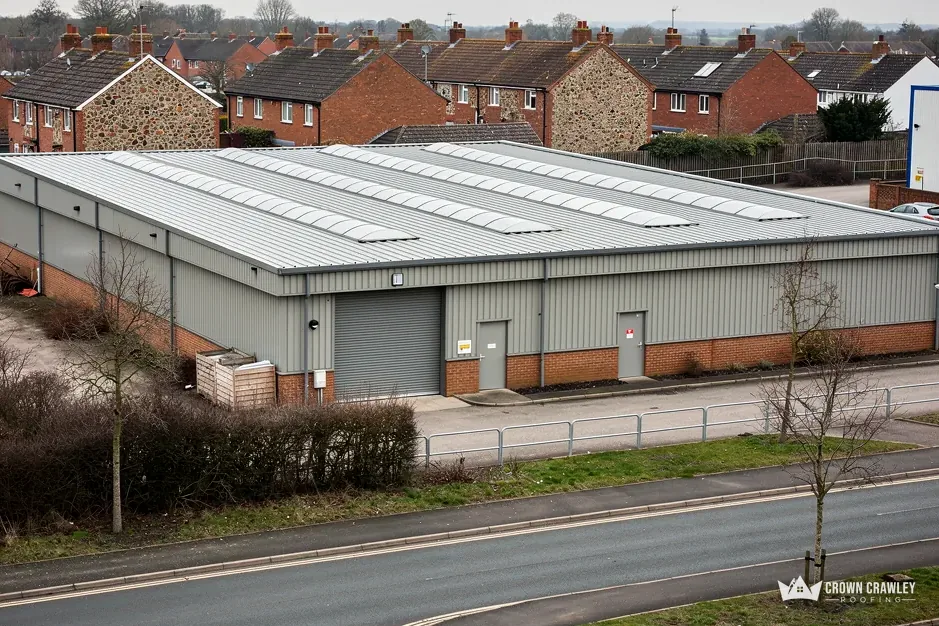
A unit on an estate such as Manor Royal has the simplest shape and the hardest access. The roof is long, shallow and often high, and the people working below are busy with deliveries and machinery. What goes wrong is usually predictable.
Where do metal-sheet roofs leak?
Rarely in the middle of a sheet. The trouble is at the laps between sheets, around fasteners that have worked loose or rusted, at the ridge and the verge, and along the cut edges where the coating has worn through and corrosion starts. Our guide to cut-edge corrosion explains why a rusty edge matters long before the sheet itself fails. Sealing laps and renewing fasteners is a repair. Fixing a new liner or overlay across a whole slope is a bigger decision, and it is the moment to ask whether the old sheets are the cement kind.
What about gutters in the middle of the roof?
Many sheds are two or three bays wide, with a valley gutter between bays. A valley gutter, sometimes called a box gutter, is a lined trough that collects rain from both slopes and carries it to downpipes. When leaves, litter or a bird's nest block an outlet, the gutter fills and spills over its lining or into the building. Clearing outlets is cheap and quick, and it is the first question to raise. Relining a failed gutter is not, which is why our answer on box gutter lining is worth reading before you agree to replace the whole thing.
Near Gatwick, one more rule can apply to a big job. The airport's own crane page asks for a permit before a crane works within 6km of the airport, except where the equipment is under 10m or screened by taller trees and structures. If a big sheet-lifting job on a unit near the airport needs a crane, ask about the permit at the quoting stage rather than on the morning.
Shops and parades: flat roofs above a trading floor
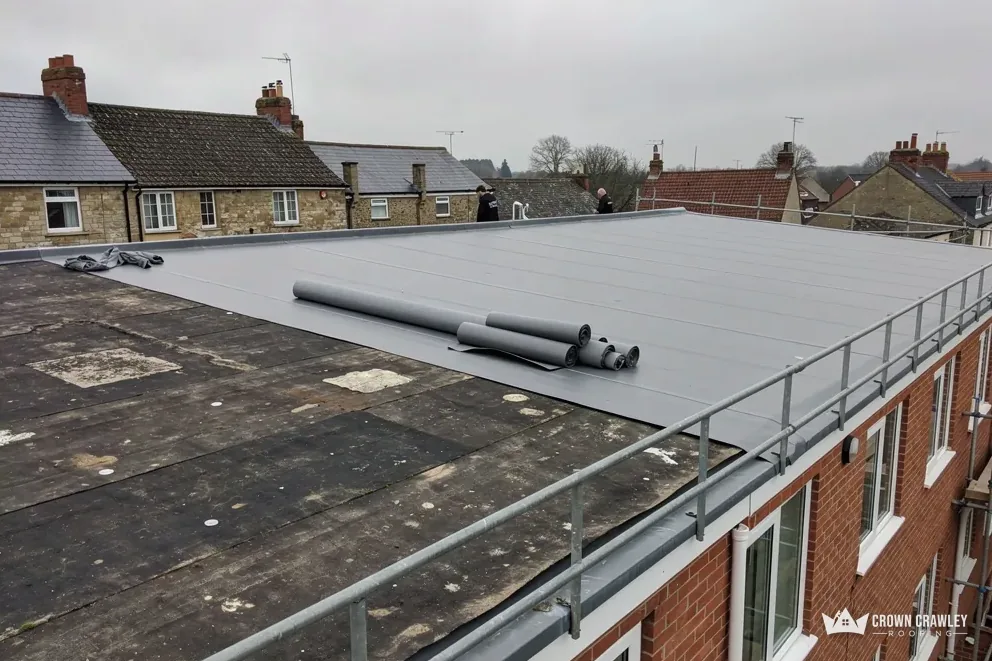
A parade of shops usually has a flat roof, a front fascia that doubles as a sign board, and a back yard with the only safe access. The covering might be felt, EPDM or a fibreglass system called GRP, and it is often older than the current tenant.
What fails first on a shop roof?
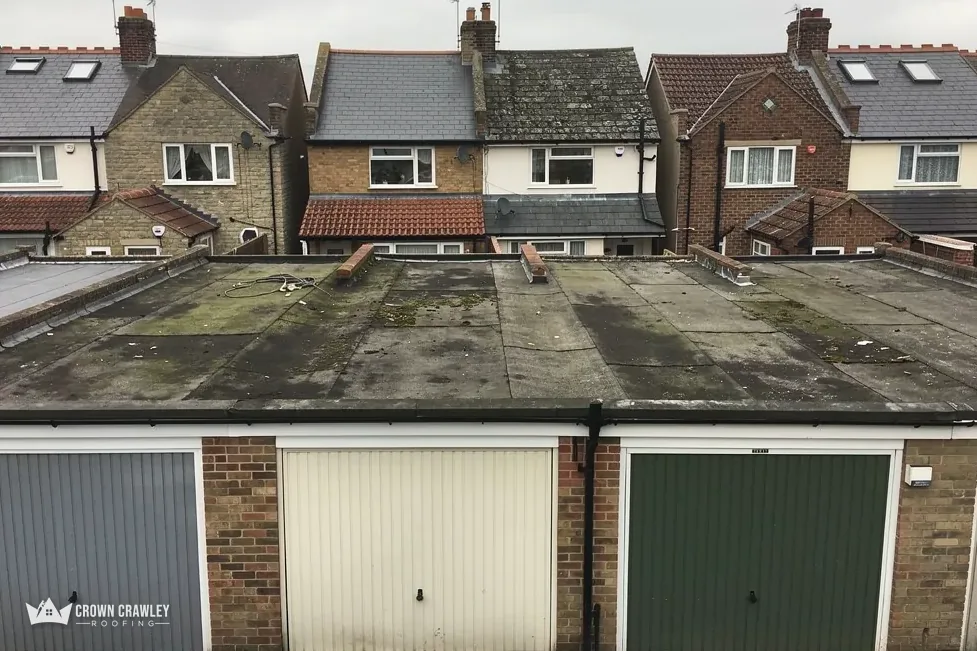
Edges, upstands and outlets. Water sits at low spots where the fall is poor, and standing water ages any covering faster. The flat roof standard, BS 6229:2025, keeps a minimum finished fall of 1:80 on general areas and internal gutters. Plenty of older roofs have less than that after years of settlement, so puddles that stay for days after rain are a warning rather than a quirk. Upstands, the short vertical lips at the point a roof meets a wall, rely on flashing and sealant that can split, and a split there lets water behind the covering and into the ceiling.
Can a shop stay open during repairs?
Often yes, if the work is planned around the building. Most roof repairs happen on the outside, with only a short disturbance inside when a ceiling tile or a rooflight is touched. Noise and dust are the realistic worries, along with where materials are stacked and how customers reach the door. Our answer on roof repairs while the business is open covers what to agree beforehand. Ask for the working days to be told to you in advance, and ask where the safe route in and out will be.
Do not lay a new covering over a wet roof without finding out why it is wet. Trapped moisture is the usual reason a new roof fails young.
Rooflights, fragile sheets and safe access
Every commercial roofer worries about the same hazard: the roof that looks solid and is not. Rooflights in older sheds are often old plastic, weathered to a brittle surface and painted over by dust or moss so they look like the sheet next to them. They take no weight at all.
What makes a roof fragile?
Rooflights, ageing plastic sheets and, above all, cement sheeting. HSE guidance on asbestos is blunt: asbestos cement roofs count as fragile every time. Weathered sheets that are not otherwise badly damaged count as non-licensed work, yet once a sheet begins breaking up and throws off significant dust, the job turns notifiable. That is a regulatory line you do not want to find by accident, so a building from before 2000 should be treated as though asbestos is present until a survey says otherwise. Our fragile roof safety guide sets out the basics of access, and our answer on industrial rooflight replacement explains how a failed light is swapped.
What should the access plan show?
Edge protection, crawling boards or covers over the lights, and a clear route from ladder to work area. If a quote says nothing about how people will reach the roof, ask. Safe working at height is part of the job, not an optional extra, and a roofer who skips the conversation is telling you something.
Offices and schools: occupied buildings and tight windows
An office block or a school has a different problem again: people. Staff, pupils and visitors are inside while the work goes on, and the building cannot simply close. Planning is the main tool.
How is noise and disruption managed?
By timing and by zoning. Work that makes noise over a classroom or meeting room can be scheduled for school holidays or weekends, and a large re-roof can be done one section at a time so the whole building is never open to the weather at once. Ask the roofer for the sequence, not just the dates. On a flat roof, that means which section is stripped first, how it is made watertight each evening, and what happens if rain is forecast. Routes for deliveries and waste need to avoid doors where children or the public enter.
What do tall buildings add?
Access and approvals. A taller building may need scaffolding that stands on the highway, and section 169 of the Highways Act 1980 bars scaffolding that obstructs a public highway unless the highway authority has issued a licence. The licence is something the scaffolder and our office handle jointly on our jobs, and the council behind it varies by address. A scaffold on private land is a separate matter that needs no licence, though a parking bay may still have to be suspended. Cranes near Gatwick follow the airport's own rules, covered above.
Ask also about the existing roof's condition and its past repairs, since a school roof patched for years can have several coverings stacked on top of each other. Our guide to a commercial roof condition survey shows what a thorough look includes.
Repair, coat or replace: how to decide
Almost every commercial owner reaches this question, and the answer comes from the roof itself, not from the lowest number on a quote. A repair makes sense when the faults are local and the rest of the covering is sound. Replacement makes sense when faults are spread across the area, when the insulation below is wet, or when the same repair keeps coming back.
What does the survey need to show?
Photographs of the covering, laps, upstands, outlets and rooflights; a note of the fall and any ponding; and a view on whether the structure and insulation are dry. Without those, any quote is a guess. Once the survey is done the quote reaches you as one written total, and it depends on access, area, the covering you choose and what the survey finds. Find out if VAT and scaffolding sit inside the figure. The standard VAT rate is 20%, which on a large roof is a big sum to discover late.
Is a coating ever the right answer?
Sometimes, on a sound metal or felt roof that has aged on the surface but not failed underneath. A coating cannot cure wet insulation, rotten decking or poor falls. Our answer on commercial roof coating versus replacement sets out the comparison. Whichever you choose, ask what warranty a manufacturer or contractor gives on the product and on the labour, and get it in writing, because a warranty is not a lifespan.
The simplest next step is to send us the building address, what the roof is clad in if you know, and where the water shows. We open with the outlets, laps and rooflights nearest that spot.
Part of our Commercial Roofing in Crawley & Gatwick
More about commercial roofs
How often should a commercial roof be looked at?
At least once after winter and once after autumn leaf fall, and straight after any storm. Outlets, laps, upstands and rooflights are the usual trouble spots, and a quick look often prevents a leak. A written record of each visit also helps if you ever need to show a landlord or insurer what was done.
Can asbestos cement sheets be repaired in place?
Sometimes, if they are weathered but otherwise sound, but an asbestos cement roof is fragile in every case, and the work must not break the material up. Treat any building from before 2000 as possibly containing asbestos. A survey comes first, and the method follows from what it finds.
Do commercial roof jobs need Building Regulations approval?
It can, particularly where the covering, the insulation or the structure changes, and the rules for commercial buildings differ from those for houses. Ask your building control body before work starts, naming the building and describing what is planned, because the answer depends on both.