Walk round an industrial estate and the roofs tell you how it grew. A shallow profiled-metal roof sits next to an older sheeted unit, beside a flat roof over an office block, with a row of rooflights running down each of them. Manor Royal and the estates beside Gatwick show the same mixture. Each roof has its own way of letting water in, and none of them can be fixed by someone who has only ever worked on houses.
Repairs on a unit also come with conditions a house never has. Lorries need the yard, staff need the doors, and an insurer or landlord may want a say before anyone climbs up. Near the airport there is one more layer, because tall equipment can need a permit. This guide sets out the roof types, the faults that turn up again and again, how a repair is planned around a working unit, and what the crane rules mean for a job.
The roof types on a Gatwick-side estate
Units on an estate are built to a budget and a deadline, then altered by whoever occupies them next. That is why one estate can offer several roof types in a single street, and why the first job on any repair is working out which one you have. Our commercial roofing page covers the full range of work on commercial buildings.
Profiled metal and sheeted roofs
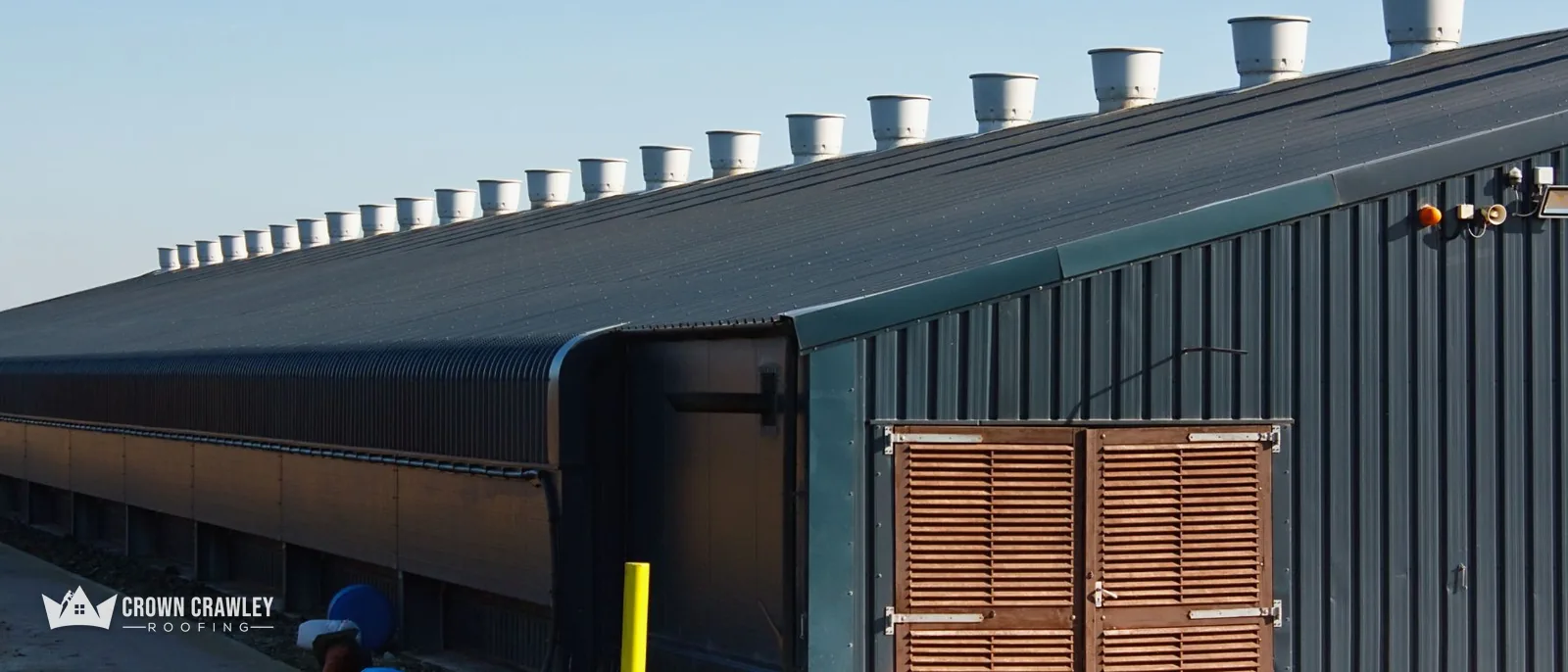
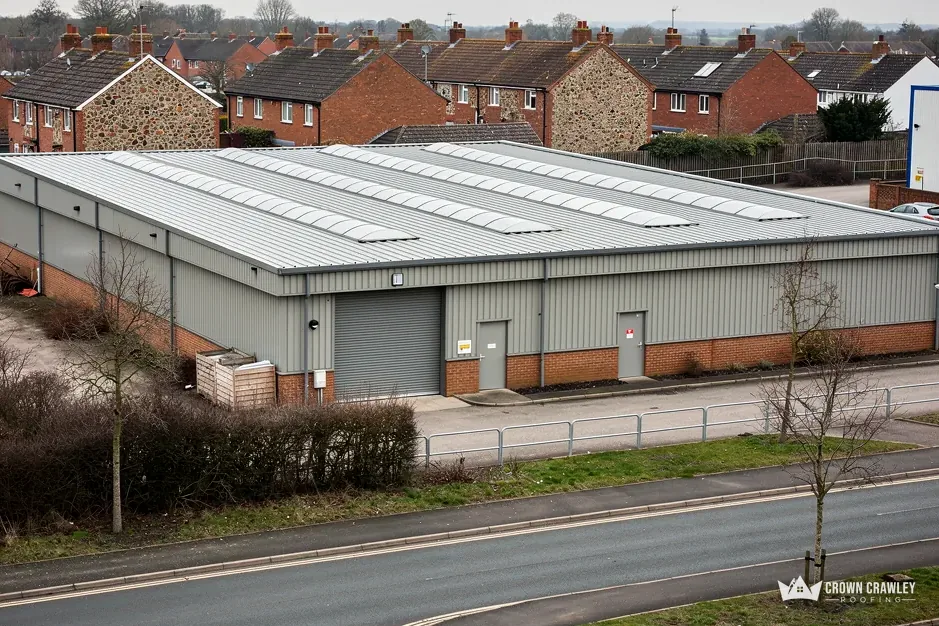
Warehouse-style units are often covered with long ribbed sheets fixed to purlins, the horizontal rails that span between the main frames. Some are a single skin. Others are double-skin or composite panels, with insulation sandwiched between the layers. Water gets in at the laps where sheets overlap, at the fixings, and at the cut edges, where the protective coating has been broken.
Fibre cement sheeting
Older units may carry corrugated sheets of fibre cement, which can contain asbestos. Before 2000 asbestos cement was a common sheeting material, and HSE tells owners to assume it is present in a building from that period. Sheets of this kind are brittle, so they count as fragile. Overcladding is one option for them, and a survey decides which route fits.
Flat roofs and box gutters
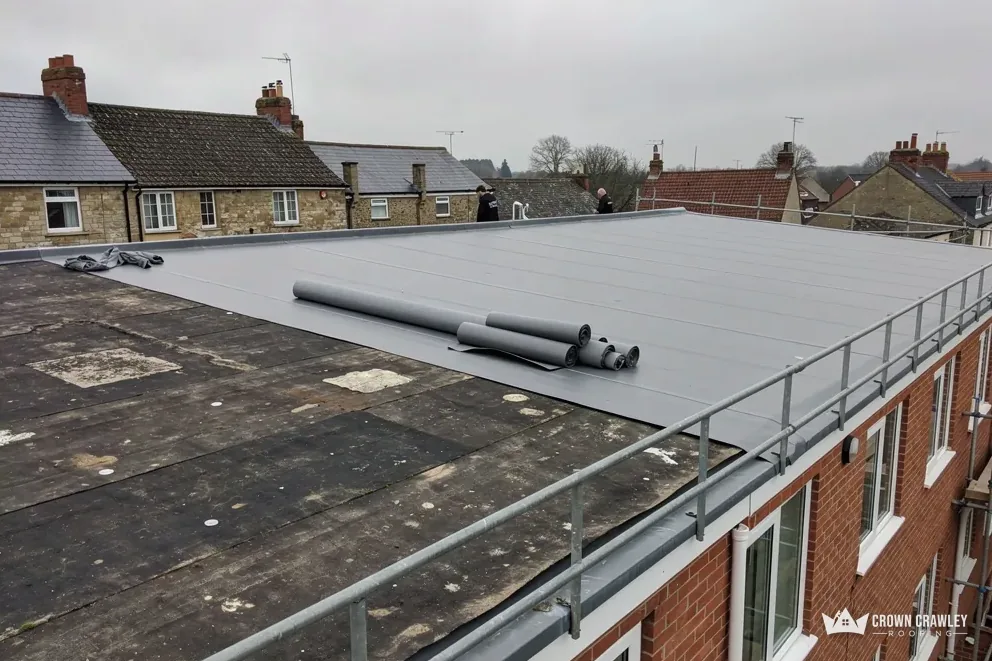
Office blocks, entrance canopies and some unit roofs are flat, covered with felt, single-ply membrane or a liquid coating. Where two pitched bays meet, a box gutter runs between them: a long lined channel that carries the whole valley's rain to an outlet. Box gutters are among the most common places for a leak to start, because one blocked outlet backs the water up over the lining.
Rooflights
Rooflights are panels in the sheeting that let daylight in. They age faster than the metal around them, and some become brittle enough that they will not take a person's weight.
Faults that keep coming back
A leak in a large roof rarely shows up under the hole. Water runs along a purlin, drops onto a ceiling grid and stains the tile three metres away. So a good repair starts with tracing the water back, not with covering the stain.
Sheet laps, fixings and cut edges
Sheeting expands in warm sun and contracts overnight. Over time the sealant in the laps hardens and splits, and the fixing screws work slightly loose. Where a sheet was cut on site, bare steel can start to rust from the edge inwards, which we cover in our guide to cut-edge corrosion.
Blocked gutters and outlets
Leaves, bird nests and wind-blown packaging collect in box gutters and outlets. The water has nowhere to go, so it rises until it finds a joint. A regular clear-out before autumn costs far less than a leak over stock.
Ponding on flat sections
A flat roof is meant to drain. The current flat-roof standard, BS 6229:2025, sets a finished fall of at least 1:80 across the main areas and in internal gutters. Puddles that are still there two days after rain suggest the fall has been lost. Water that sits there for days ages the membrane quicker.
Plant, cables and penetrations
Extraction fans, air-conditioning units, solar fixings and cable routes all pass through or sit on the roof. Each hole needs a proper upstand and seal. These details are often disturbed when a tenant installs new plant, and the leak appears weeks later with nobody linking it to the visit.
Birds are another repeat problem. Pigeons roost in the valleys and foul the gutters, and our answer on pigeon proofing an industrial roof deals with that.
Mending a roof over a trading unit
On a house the occupants can usually step out of the way. On a unit the business cannot stop, so the plan has to fit round the work below. We cover the wider questions in our answer on roof repairs while the business is open; here are the points that matter most on an estate.
Who needs to know before work starts?
Start with the person who controls the building. For a rented unit that may be the landlord, the managing agent or the tenant, depending on the lease, and our answer on who pays for commercial roof repairs sets out how that usually divides. Then the site manager needs the work plan: where the access is, which yard areas will be fenced off, and which doors stay clear for deliveries.
What changes day to day?
Noise, dust and falling debris are the three things to control. Sheeting that is removed from above a production area is covered in again before the end of the day, and a debris net or a protected walkway goes in where staff pass underneath. Where the job needs hot work, such as torching felt, the unit's fire arrangements come first and the roof is checked before we leave.
Does a bigger job fall under CDM?
Construction work for a business falls under the CDM regulations, which set out planning, safe access and who is responsible for what. We have a separate answer on CDM regulations and roof work that explains the duties for the client.
Cranes and tall equipment near the airport
Lifting sheets, plant or pallets of membrane onto a unit roof often means a crane or a tall hoist. Close to Gatwick, that lift needs checking before anyone books the lorry, because the airport runs its own permit for cranes.
When does the airport want to be asked?
The test Gatwick publishes is distance and height. A crane working inside 6km of the airport needs the airport's permit, unless the machine stays under 10m or has taller trees or buildings standing close around it on every side. The application goes by email to the airport's cranes team, in step with the application to the Civil Aviation Authority. Conditions can attach to the permit, including limits on hours and height, so plan the lift date and the lift height together.
What does a permit cost?
Since March 2022 every crane application carries a charge. The airport's entry-level permit, which needs no technical assessment, is listed at £300 plus VAT, and the higher tiers run up to £3,000. Settle the lifting method early: equipment kept under the height limit can avoid the permit altogether.
Does scaffold need a permit too?
The airport's crane page is silent on ordinary scaffolding, so we handle scaffold as normal and keep the permit for lifting equipment. The same page says that drone flying within 5km of the airport is restricted, so check the rules before any drone survey of a roof here.
What about the wider area?
Since November 2024 the airport's safeguarding area has stretched out to 55km, and the airport is a statutory consultee in the planning process, so new plant or a raised roof structure can reach its desk. Whether your unit sits inside the 6km circle depends on its exact position, so measure it against the airport's guidance and tell us the answer. Our post on Gatwick crane permits for roofing goes into the process in more detail.
Access, scaffold and fragile surfaces
Reaching a high roof safely is half the cost of the job. The method depends on the building, the work and the ground beside it.
Scaffold, towers and edge protection
A long eaves line is usually protected with edge scaffold or a proprietary edge system, and a hoist or a mobile tower serves the rest. A scaffold standing wholly inside the unit's own yard needs no highway licence. One that obstructs the public highway falls under section 169 of the Highways Act 1980, where the highway authority issues the licence. Ask who applies; we settle that with the scaffolder before the job. Estate roads can be private or public, so check which yours is. Our answer on roof edge protection requirements adds the detail.
Walking on the roof
HSE says asbestos cement roofs are always fragile, and the same caution applies to old rooflights and to any sheet nobody has tested. Nobody should step on a rooflight or a sheet that is not known to be sound. Crawl boards, covers over lights and a rope line are standard, and our guide to fragile roof safety sets out the methods.
Surveys from the ground
A first look does not always need anyone on the roof. Binoculars, a view from the next unit and a walk inside with a torch along the purlins will often show a lot. A roof access hatch or fixed ladder, where there is one, tells you who has been up there before and what they left behind.
How a repair on your unit is priced
We survey first, then give you one written total price for the work, so you can set it against your budget and your landlord's consent. Cost on an industrial roof depends on the area, the height, the access, the roof covering and what the survey finds under it. For roof area and access alone the difference between a low unit with a yard in front and a tall one hemmed in by neighbours can be large. The price follows the visit, because a per-square-metre figure for a commercial roof says little about your building.
What helps the survey?
The following save time and help us read the roof before we arrive:
- the unit address and a contact on site who can open gates and doors;
- any asbestos register or survey for the building;
- the age and covering of the roof, if you know them;
- where the water appears inside, and when it appears;
- any warranty paperwork or earlier repair invoices.
Is a repair enough?
Sometimes a few new laps, a re-lined gutter and some fresh sealant will carry a roof for a good while. Sometimes the sheeting is past it, and layering patches on top costs more than it saves. We say which it is, with photos of your roof beside the explanation. Our guide to a commercial roof condition survey shows how that assessment works.
To start, send us the unit address, a contact on site and a few photos of the leak inside and the roof from the yard. We then book the survey around your delivery times.
Part of our Commercial Roofing in Crawley & Gatwick
Questions on estate roof repairs
Do I need a Gatwick permit for a roof repair on a Manor Royal unit?
Only if the job uses a crane within 6km of the airport. The airport's exception covers equipment under 10m high or screened by taller trees or buildings on every side. Check your address against the airport's guidance, then tell us the result before we book any lift.
Can the roof be repaired without closing the unit?
Often, yes. The work is planned around deliveries and staff routes, with fenced yard areas, protected walkways and any open section of roof covered in again before the working day ends. The exceptions are jobs over sensitive areas or hot work, where we agree the plan with the site manager before anyone starts.
Who should arrange the repair, the landlord or the tenant?
That depends on the lease. Many leases give the landlord the structure and the roof, and tenants the fit-out below, but wording differs, so read the repairing covenant before you instruct anyone. Tell the managing agent early, since consent can take longer than the roof work itself.