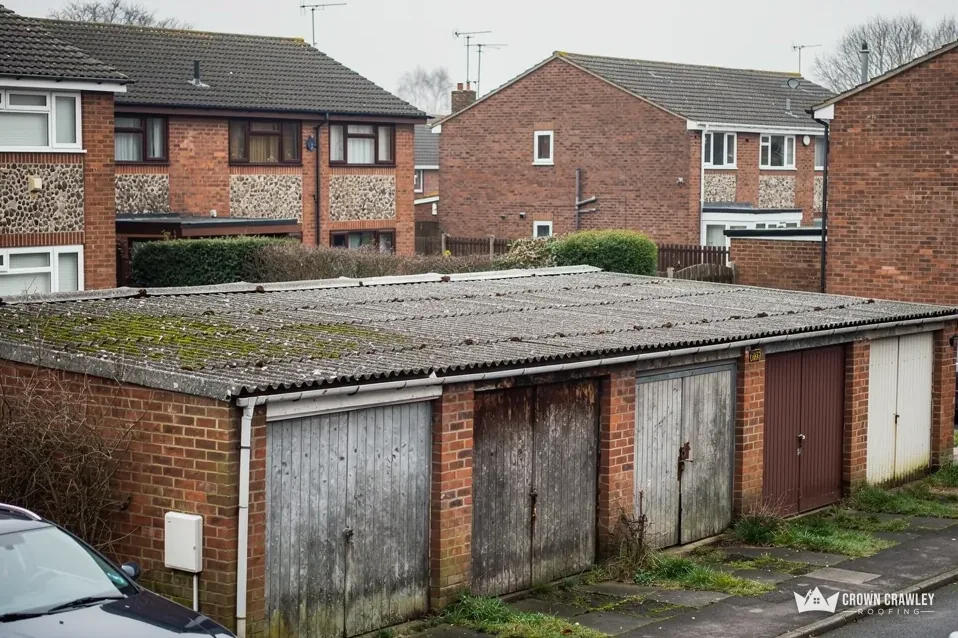
Blocks of lock-up garages are a familiar sight around Crawley. Crawley became a designated new town in 1947 and grew neighbourhood by neighbourhood after that, and garage courts, flat-roofed blocks and rented lock-ups went up alongside the houses. Many of those roofs have been patched, painted or ignored for a very long time, and some are covered in corrugated sheets that nobody has ever looked at closely.
The Health and Safety Executive gives a plain rule for any building of that age: if it was built or refurbished before 2000, assume there is asbestos in it. That does not mean every garage roof is dangerous, and it does not mean you need to panic. It means the sheets get tested before anyone drills, cuts, pressure-washes or walks on them. This post walks through the decisions in order: finding out what the sheets are, what the rules allow, whether to cover over or strip off, and where the waste goes. Treat this as general information rather than legal advice; for questions about your own roof, the HSE's asbestos guidance is the place to check.
Is your garage roof asbestos cement?
Asbestos cement is a grey, slightly rough sheet made from cement and asbestos fibres. It was used for roof sheeting and rainwater goods, which is why garages, sheds and outbuildings so often have it. You cannot tell by looking. HSE points out that asbestos items and their non-asbestos equivalents are hard to tell apart, so the colour, the profile and the moss on top prove nothing either way.
What clues point towards asbestos?
Age is the main clue. A block built in the 1950s, 1960s or 1970s with large corrugated grey sheets, or flat sheets on the soffit and fascia line, deserves a test before any work. Newer fibre cement sheets look almost identical and do not contain asbestos, which is exactly why a lab result beats a guess. Ask whoever manages the block whether a survey already exists. A landlord, a management company or the council may hold one.
What should you leave alone until you know?
Do not drill, scrape, brush or jet-wash the sheets, and do not fix a satellite dish, a light or a gutter bracket to them. HSE warns that a roof of cement sheets can give way underfoot, so nobody should step onto one without crawling boards and edge protection. A person who steps through a sheet is hurt by the fall first and exposed to the fibres second. If a sheet is cracked, leave it where it is and have it assessed before anyone tries a repair. Our guide to asbestos surveys before re-roofing explains what the testing visit involves.
Testing the sheets before any quote
Testing means a small sample is taken by a trained person and sent to a laboratory that analyses it. The result comes back as a written report that either names asbestos or says none was found. That report is the document every contractor will want to see, and it lets them price the right job from the start rather than guess.
Who should take the sample?
Someone who knows how to take it without breaking the sheet into dust. A careful sampler keeps the sheet wet, works away from the edge and makes the spot good afterwards. Avoid the do-it-yourself kits that ask you to snap off a corner. If the sheet is sound now, it should not be disturbed to find out what it is.
What does the report change?
It changes who can do the work and how the job is priced. A garage roof that comes back negative can be treated as any other flat or low-pitched roof, and our flat roofing survey would then look at the deck, the falls and the covering. A positive result brings the HSE rules in the next section into play, along with the question of whether to remove the sheets or cover them. Either way, you hold evidence rather than a hunch.
When we survey a garage roof we photograph the sheets, the fixings and the underside where it is visible, share the pictures with the owner, and ask for the lab report before a written price is prepared. The single total price follows once we know what the sheets are and how much roof there is to cover.
What HSE says about non-licensed removal
HSE does not reserve every kind of asbestos work for firms that hold a licence from it. Roof sheeting and rainwater goods made of asbestos cement count as non-licensed work when they come away intact and are handled with care. HSE adds that cement which has weathered, without being badly damaged, still fits that category. A garage roof of sound, mossy sheets can therefore fall on the non-licensed side.
What changes if the sheets are damaged?
HSE's guidance on asbestos cement says that once sheets begin to crumble and throw off real dust, the job moves into the notifiable non-licensed group. HSE must then be told before work starts, and a register of health records has to be kept for 40 years. Sheets that are badly damaged or already in pieces belong in that group. Broken sheets are more common on an unloved roof than on a cared-for one, which is another reason to have the condition assessed first.
Is all asbestos in a garage the same?
No. Asbestos insulating board is a different material from asbestos cement. HSE lists external soffits among the places it turns up, and removing insulating board is mostly work for licence holders. If your garage block has soffit boards or panels behind the fascia, ask the surveyor to name each material separately. Never assume a whole roofline is the easier cement type. Our page on asbestos soffit boards covers that side of the question.
Whoever removes sheets should have training for the job, a method statement that controls dust, and the correct protective equipment. Ask to see those before a start date is agreed.
Overlay or strip: which route suits a garage block?
There are three choices. Leave the roof alone and monitor it, cover it over, or take the sheets off and fit a new roof. Which one is right depends on the sheet condition, the structure underneath and who owns the building.
When can you leave it alone?
If the sheets are sound, dry and not leaking, leaving them in place and checking them each year is an option. The risk grows as moss, frost and age crack the surface, and a roof that already lets water through is past that stage. Record what you know and tell anyone who works on the building later.
What does overlaying involve?
Covering over means a new roof system goes on top of the existing sheets, so the asbestos stays where it is and is not disturbed by removal. That can keep the cost and the dust risk down. The trade-offs are that the old sheets remain fragile underneath, the new fixings must go through or around them without breaking them, and the asbestos still has to be recorded for the next owner or contractor. Whether a deck of the existing sheets will carry a new system is a question for the roofer and, where the roof is large, a structural opinion. Our page on overcladding an asbestos roof sets out how that route works on bigger buildings.
Why strip and replace?
Removal deals with the problem once. Once the sheets are gone, a proper deck, insulation and a flat roof covering can go on, with falls built in so that water runs to the gutter. Where the old roof is damaged or the structure is tired, removal is usually the cleaner answer, even though it asks more of the contractor and the waste carrier.
Where the waste goes
Sheets that come off a roof become hazardous waste the moment they are lifted, and they cannot go in an ordinary skip or a builder's bag, so ask the council before taking any to a tip. HSE's guidance on asbestos waste says it should be double-wrapped and labelled. Sheets are lowered by hand rather than thrown, wrapped in heavy-duty polythene and sealed, and stored where they cannot be broken or climbed on until the carrier collects them.
Who is allowed to carry it?
Any firm that carries the waste for you must be a registered waste carrier. The government register shows upper-tier carriers, who may carry waste for others, and you can look a company up before you hire it. Ask the contractor for the carrier registration number and the name of the site that will receive the load. The household exemption from consignment notes applies to domestic hazardous waste but excludes asbestos waste, so a consignment note should still accompany an asbestos load from your home.
What paperwork should you keep?
Keep the lab report, the written method for the job, the consignment note and the carrier details together in one folder. They show what was found and where it went, and a buyer's solicitor or a later contractor will be glad to see them. If a quote does not mention waste at all, ask what happens to the sheets. A single total price should include disposal, so check that it does, along with scaffolding and VAT, before you compare one quote with another.
Crawley garage blocks: who decides?
A lock-up block raises a question a private garage does not: who owns the roof? Sometimes a single landlord does, sometimes a management company, and sometimes each garage is owned separately under a shared structure. Before anyone orders a test, find out who looks after the roof, and who pays. A repair done by one owner to a roof shared by eight can cause a dispute that has nothing to do with the sheets.
What do you need to agree first?
Agree who instructs the survey, who sees the lab report and how the cost is shared. If the block belongs to a landlord or housing provider, put the request in writing and ask for any existing asbestos record. If you own your garage freehold, talk to the neighbours either side, because the roof, the party walls and the guttering are usually continuous.
Does a replacement roof need approval?
Possibly. Crawley Building Control's guidance asks for approval once more than 25% of a roof's surface is replaced, and a garage block roof can cross that line with ease. Outside Crawley the national test from the Planning Portal is less than 25 per cent of the building envelope and less than 50 per cent of the roof. Replacing the covering on a flat roof can also count as renovation under Part L of the Building Regulations. Put the question to your building control body ahead of the work, not once it is done.
For a flat-roofed block, a modern covering such as GRP or EPDM is the usual replacement. Our comparison of GRP, EPDM and felt for garages sets out how they differ. Send us the lab report, the number of garages and a few photos of the sheets, the guttering and the fascia line. Our first check on site is the condition of the sheets at the fixings, then the deck or purlins below them, then how the water leaves the roof. From those we can describe the realistic options for your block before a price is written.
Part of our Flat Roofing in Crawley
More about asbestos garage roofs
Can I take down asbestos cement garage sheets myself?
HSE classes work on sound asbestos cement as non-licensed, so an owner is not banned from handling it, but the sheets are fragile and the fibres are the risk. Many owners hire a trained contractor for the lifting, wrapping and carrying. If you do any of it yourself, read the HSE guidance first and keep the sheets whole.
Is a mossy garage roof more dangerous than a clean one?
Moss does not release fibres by itself. The danger comes from disturbing the sheet, so scraping or jet-washing the moss off is the worst thing to do. Leave it, have the sheet tested, and let a trained person decide whether to clean, cover or replace the roof.
Do I have to tell a buyer about asbestos in my garage?
A buyer's survey or solicitor will probably ask about it, and a lab report with the disposal paperwork makes that conversation simple. Clear records help a sale. If you are unsure what you must disclose, ask your solicitor, because this post cannot give legal advice.