
The tile-hung watermill
The county history calls the watermill tile-hung almost to the ground. That is a wall covering, and wherever it meets a roof slope the flashing and the cut tiles decide if rain stays out.
Tile-hung wall meeting a roof
Roofs in a village where the Tillingbourne meets the Wey.
Shalford is a village south-east of Guildford, home to a tile-hung watermill, Grade II listed buildings and a common to the east. Our surveyors judge each roof on its merits, then quote one total.
The county history calls the watermill tile-hung almost to the ground. That is a wall covering, and wherever it meets a roof slope the flashing and the cut tiles decide if rain stays out.
Tile-hung wall meeting a roof

Shalford has listed buildings, among them 2 Pound Place with 69 Station Road, and Fosters Row. Work that alters a listed home's character can need consent, so the council hears from us early.
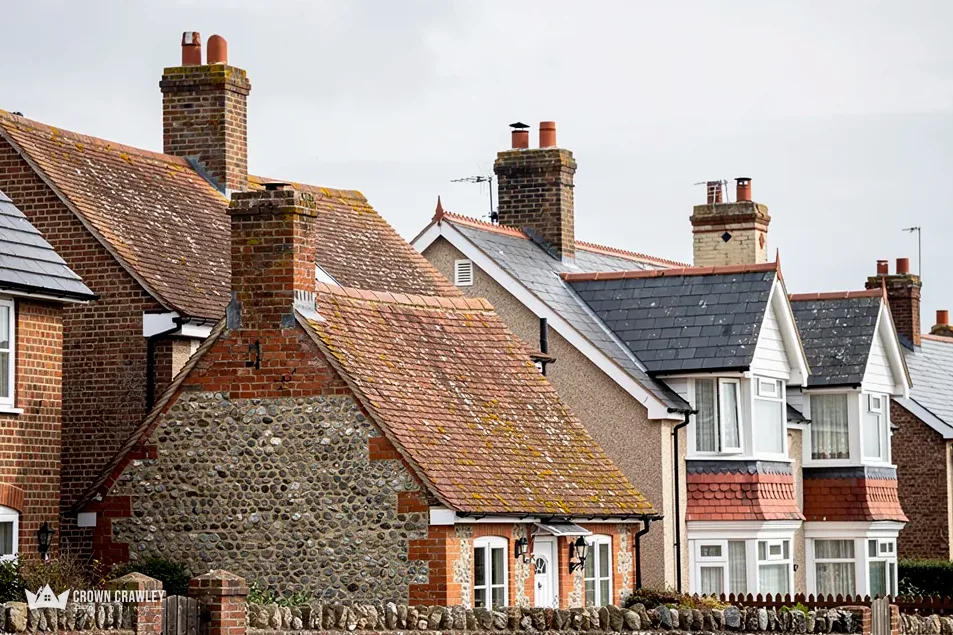
Old brick house with tiled roof
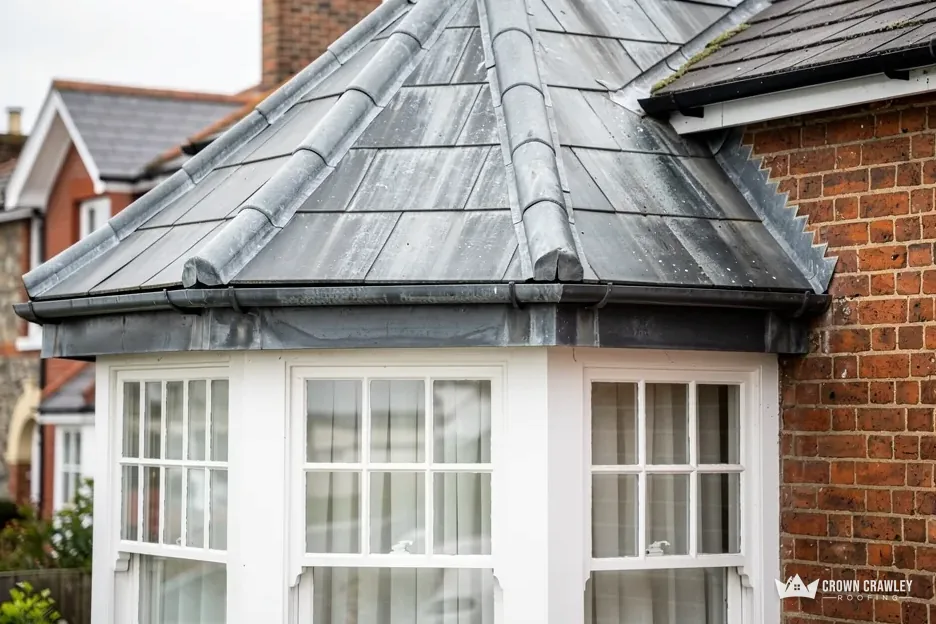
The church rebuilt in 1789 had a squat tower under a domed copper roof. Sheet metal is a trade of its own, and we tell you when a job wants a specialist and not a tiler.
Lead and metal roofing detail
Map of Shalford and the neighbourhoods around it, with Crawley for reference.
Shalford sits where the Tillingbourne joins the River Wey, mainly on Lower Greensand, with Shalford Common lying to the east.
Above the Wey valley
Three chapters: how tile hanging changes the roof edge, what a Grade II home asks of you, and which Guildford and Surrey offices to ring first.
Stage 01 · First look
A mill hung with tiles almost to the ground shows how this village used clay, and why the join with the roof deserves attention.
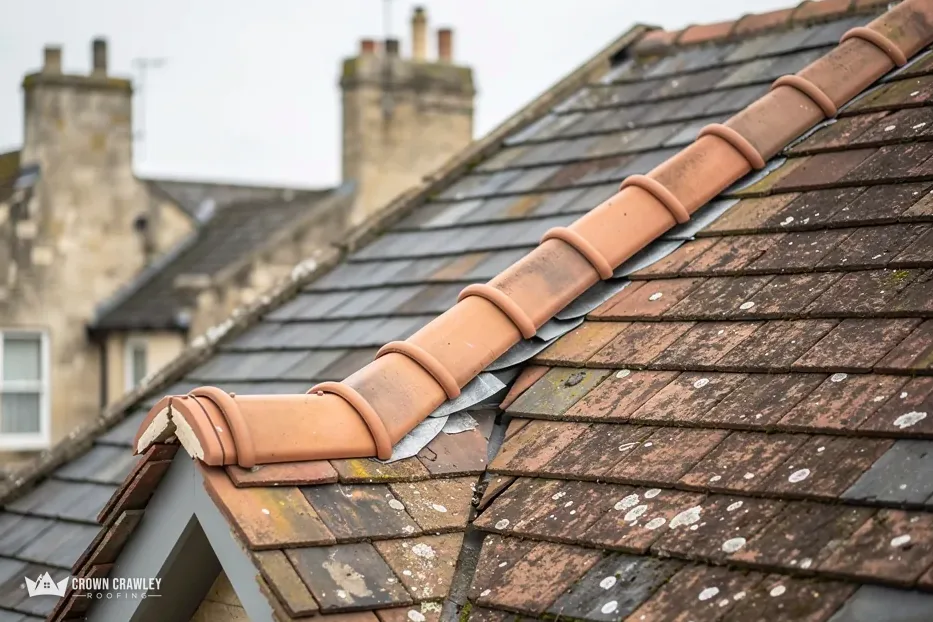
The 1911 county history says the little watermill at Shalford is tile-hung almost to the ground, with a large upper storey projecting on wooden pillars. It shows clay tile doing duty on a wall as well as on a roof. For a roofer, a tile-hung wall means more joins. Every place where a roof slope meets that cladding needs a flashing, and every flashing is a spot where water can find a way past.
Tile hanging is a skin of small tiles fixed upright to battens on a wall, mainly to shed rain. It looks like a roof, yet it is not built for the volume of water a roof slope delivers. Where the two meet, the water has to be steered out over the wall tiles by a flashing, and soakers help: small folded sheets of lead slipped under each course of tiles so nothing can slide behind. When lead lifts or a tile slips, rain runs down the inside of the cladding. A survey checks these joins and photographs any damage found.
Slowly, and a section at a time. Old tiles can be brittle, and a lifted tile may snap against its neighbours. We take off as little as we can, repair the lead or swap the broken tiles, and match colour and profile as closely as the market allows. The lead work page describes how flashings are cut and fixed, and why one worn length can often be renewed alone. If the trouble is wider than a flashing, you hear that, with pictures of where it begins.
Terms on a tile-hung wall
The county history also records that Shalford House, built in 1608 to 1610, was raised in stone and brick according to its building accounts. Most houses today are far newer, so we never guess age from the street. The roof itself tells us: tile profile, batten size, whether the underlay is felt or a breathable membrane, and the manner of the ridge and verge finish. After that comes the loft, for daylight through the covering, damp timber and insulation pressed against the eaves. You receive photographs and one total price in writing. On a tile-hung gable we also look at the bottom edge of the cladding, where tiles near the ground can stay damp and lose their faces, and at any gutter or downpipe that sprays water onto the wall. Those two causes produce many of the stains people blame on the roof.
Stage 02 · Consent
A listed home needs a different conversation before any roof repair, and it starts with the council rather than the roofer.
Shalford has several Grade II entries on the National Heritage List, among them 2 Pound Place, including 69 Station Road, first listed on 21 May 1985, plus the County First School and Fosters Row. Listing protects the character of a building, and the roof carries a big share of it.
Under section 7 of the 1990 listed buildings Act, any alteration affecting a listed building's character must be authorised, and listed building consent is how that happens. Whether a given repair counts depends on what is done and how the roof was made, so the council decides, and a roofer should not. The right first step is a call or email to Guildford Borough Council's planning team describing the repair, with our survey photographs attached if you have them. We do not start on a listed roof until you hold the answer.
If your home is listed
We aim to keep the original covering. That means lifting and relaying tiles that are sound, replacing only those that have failed, and matching profile, colour and lap. A note is kept of what came off and what went back, so the next owner or the council can read the history of the roof. We steer clear of switching materials, since a different covering alters both the weight and the look, and where a covering gets heavier, the Planning Portal tells owners to have the timbers judged by a structural engineer or surveyor beforehand. Where a whole slope on an older home is spent, the roof replacement page describes how the survey and the price are put together.
Guildford has designated a Shalford Conservation Area, while the Wey and Godalming Navigations Conservation Area follows the river nearby, so listing is not the only extra layer to raise with the borough council. If your house is unlisted, work that leaves its appearance unchanged needs no planning step. If you are unsure which applies, search the heritage list, or ask the council, and either answer helps us plan the work at no cost to you. Churches and chapels follow separate routes again, so tell us at the first contact if the building is used for worship. It also helps to keep any earlier paperwork for the house, such as old consents or a surveyor's report, because it can shorten the council's questions. A short note of dates and materials is enough to get the conversation started.
On a listed home the question for the council comes before the quote.
Stage 03 · On site
Guildford handles building control, Surrey County Council handles the highway, and each publishes its own terms for roof jobs.
When a repair is small, the practical side is easy: a ladder, a few tiles, an afternoon. A bigger job brings scaffold, a licence when the frame sits on the road, and sometimes a visit from building control. Shalford lies within Guildford Borough, which handles planning and building control, while the road and pavement belong to Surrey County Council.
Only a scaffold on the public highway needs one, and a pavement counts. Surrey County Council wants applications lodged 10 working days or more before the scaffold should rise, and prices a licence at £208 per 28 day period, with the same fee on renewal and an application fee that is not refundable. Nothing on the council's page says who applies, so we ask, split the paperwork with the scaffolder and set the date to suit. A front garden wide enough for the frame keeps the poles off the road and the licence out of the picture. The council also asks for a layout drawing of where the scaffold will stand, which is another reason to settle the position at the survey and not on the morning. The licence fee covers 28 days, so a tidy programme, with materials ordered before the poles go up, keeps the bill from running on for a second period.
Offices to ask first
Guildford Borough Council describes building control as an independent service run not for profit, and it is the office that answers questions on re-roofs. The Planning Portal's national yardstick is under 25 per cent of the building envelope and under 50 per cent of the roof before approval becomes necessary, and a covering at least 15 per cent heavier calls for approval however small the area. For anything bigger than a repair, we put the question to the council ahead of a start date. Our pitched roofing page explains the repairs that usually come first: tiles, battens and underlay.
Roofs can also hold wildlife. Bats are protected too, with roof work named in GOV.UK's guidance as something that can affect them. Birds get cover too while a nest is occupied. So any trace found at the survey means that corner of the job waits while we talk to you. Easiest start: write to us with a photo of the problem area and your Shalford postcode, and a surveyor will phone to book a visit.
Where a roof slope meets tile hanging, lead flashing and soakers lead water out over the wall tiles. If the lead lifts or a tile slips, rain runs down behind the cladding and may only show indoors much later. We trace the stain to the join, photograph the cause and put the repair in one written price.
Guildford Borough Council's planning team can confirm it, and the national heritage list is searchable online by address. Shalford has several Grade II entries, so checking before any roof work is sensible. If your home is listed, the council decides what needs consent, and we wait for its answer before starting anything on site, then work to what was agreed.
Surrey County Council asks for a licence application 10 working days before you want the scaffold up, and quotes a processing time of 10 days. A licence costs £208 per 28 day period. We plan the start around those dates, use your drive when there is room, and give you the timetable before anything is booked.
Sheet metal such as copper, lead or zinc is a trade of its own, and a church dome is specialist work. We handle lead and domestic roofs. If yours needs another skill, we tell you so at the survey and explain what to ask the next contractor, so you are not left guessing about who to call.
Email a picture of the tile-hung join or slope that bothers you, with your Shalford postcode, and a surveyor will phone to book a visit.
Message us on WhatsApp




