Roofs facing the London road
Norbury lies on the London road, so scaffold may have to meet the pavement. Access, and any licence that follows from it, is planned at the survey, before we offer you a date.
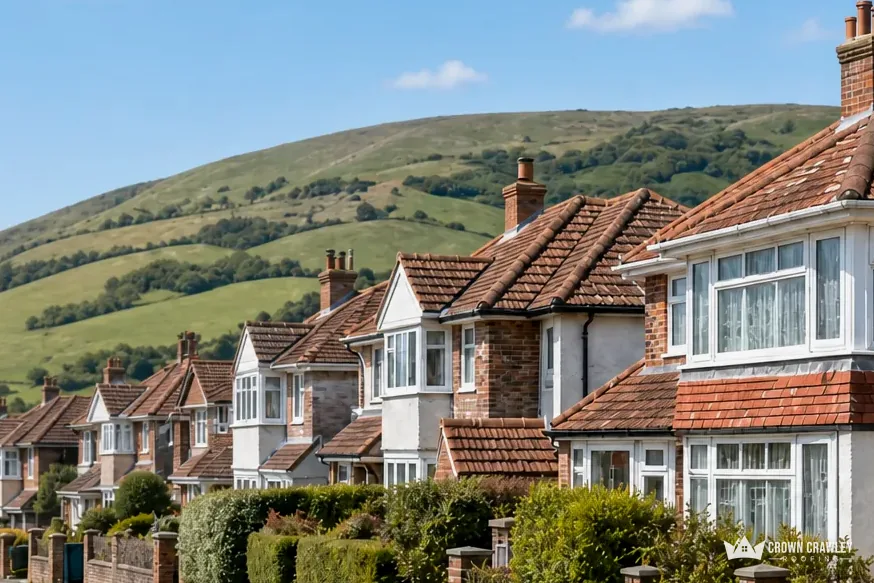
Tiled roofs along a suburban road
Roofs in a London road suburb on Croydon's northern edge.
Norbury sits on the London road where Croydon meets Streatham. Its roofs get a proper survey from us, pictures of what we find and a single written price.
Norbury lies on the London road, so scaffold may have to meet the pavement. Access, and any licence that follows from it, is planned at the survey, before we offer you a date.
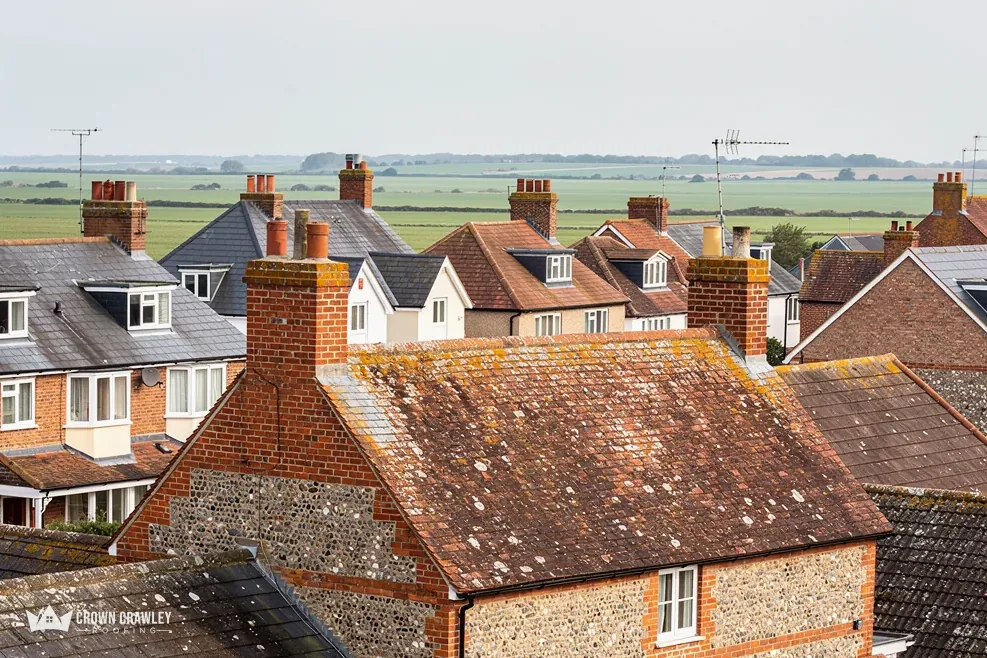
Tiled roofs along a suburban road
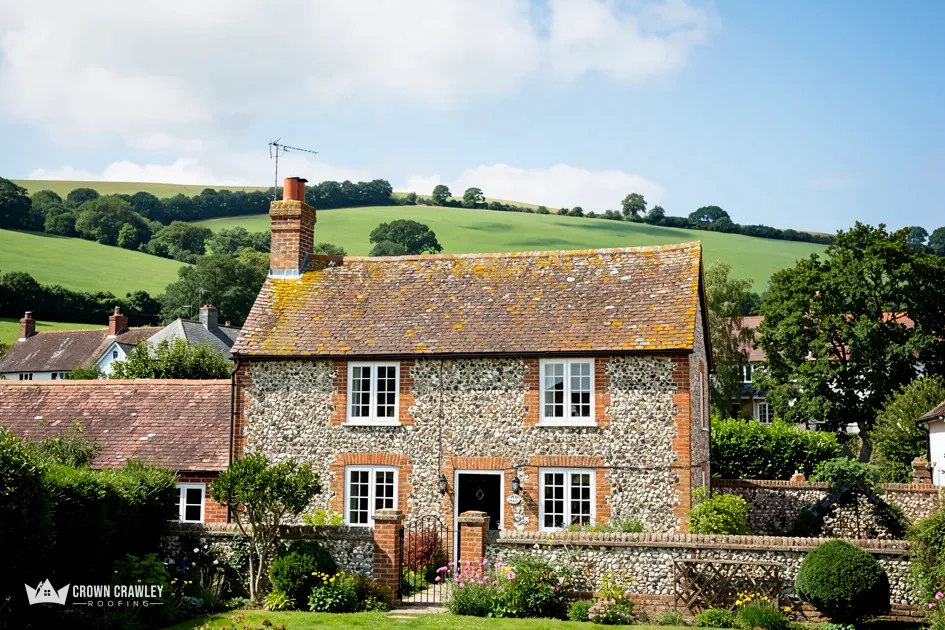
Barclays Bank and Norbury Hall hold Grade II listing. Should your house also carry a listing, its roof comes under the same consent regime, so Croydon's planners are asked before any price is set.
Historic building with a tiled roof
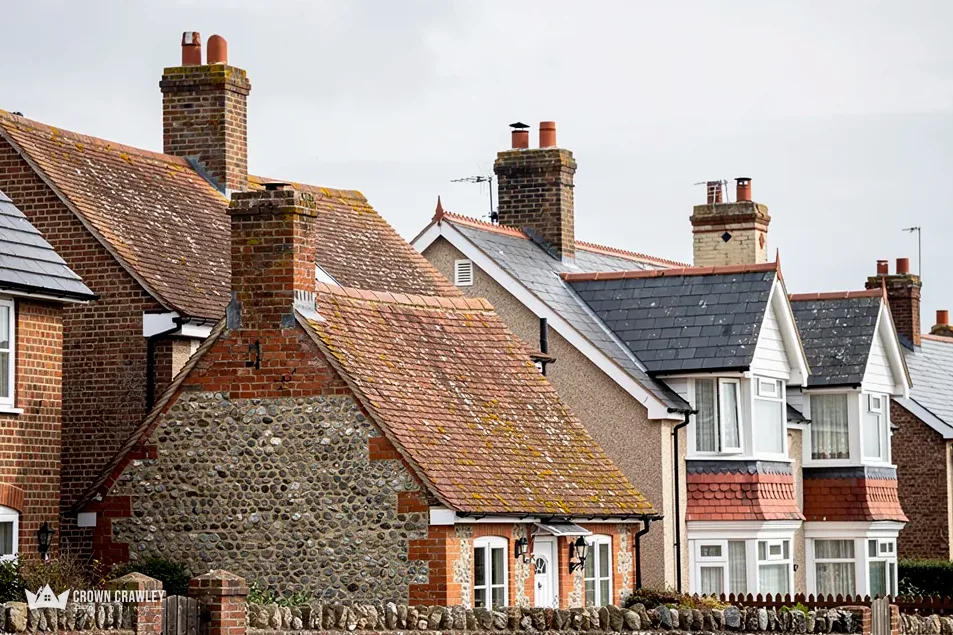
Norbury borders Streatham, so confirm which council covers your address before asking about planning. We check the borough at the survey, and we put the question to the right team for you.
Terraced homes with pitched roofs
Map of Norbury and the neighbourhoods around it, with Crawley for reference.
Norbury lies on the London road at the northern edge of the London Borough of Croydon, next to Streatham.
The Norbury job diary
Three short chapters on reading a roof without assumptions, Croydon's scaffold licence, and the planning and building control questions on a London borough roof.
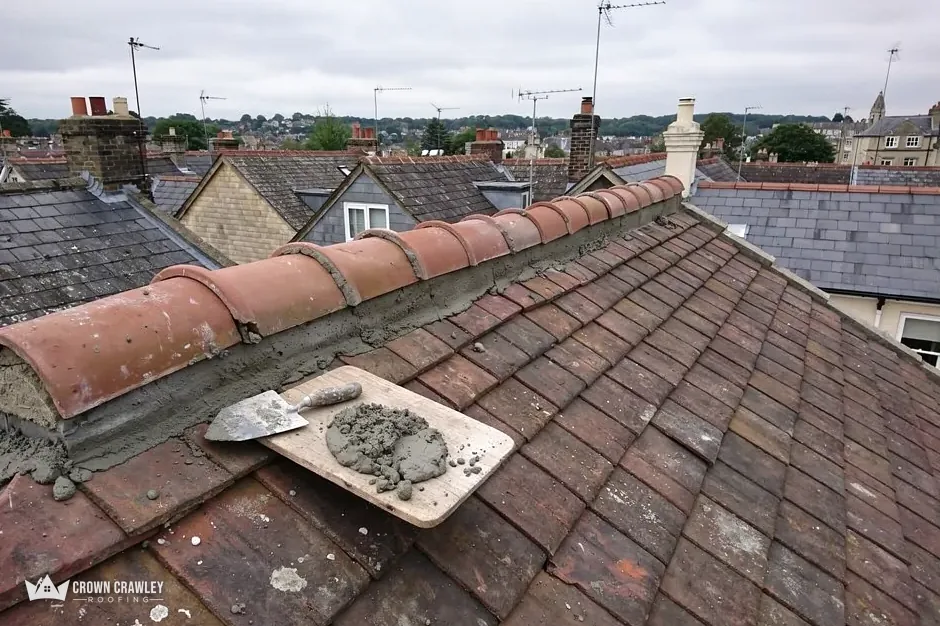
Stage 01 · First look
Norbury's recorded history runs from a medieval manor to churches begun in 1901 and 1908, but a roof's age is read from the roof itself.
Norbury's recorded story starts with a manor. The Victoria County History places it in the hands of Nicholas Carew of Beddington, who received a grant of free warren in his Croydon lands in 1375, and it notes that in 1912 the churches of St Philip and St Stephen were still unfinished, their foundation stones laid in 1901 and 1908. Those dates stretch across more than five centuries, a good reason to avoid assuming anything about the house in front of us. Two roofs on one street can have been laid generations apart, and a postcode cannot say which is which. The survey can.
What a Norbury survey checks
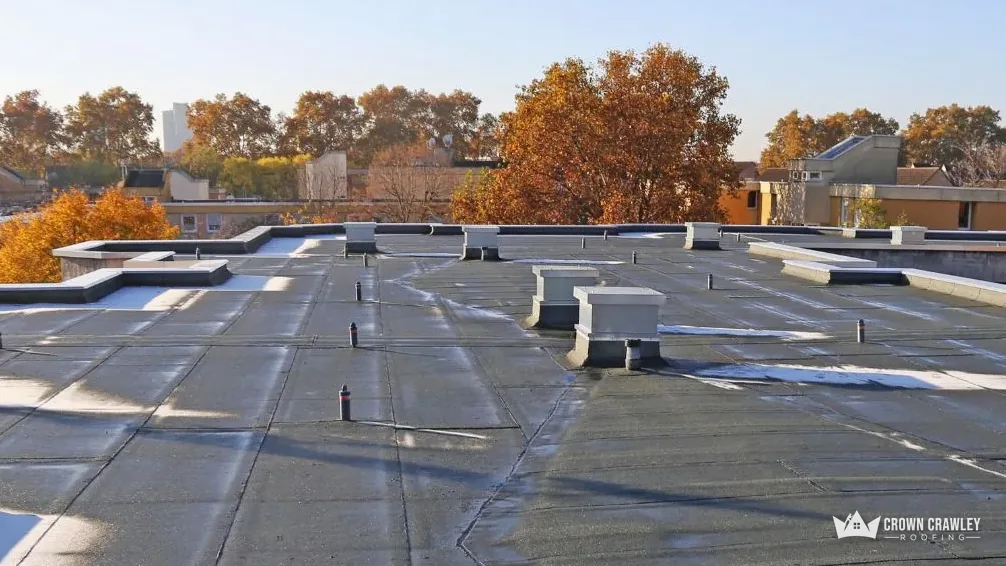
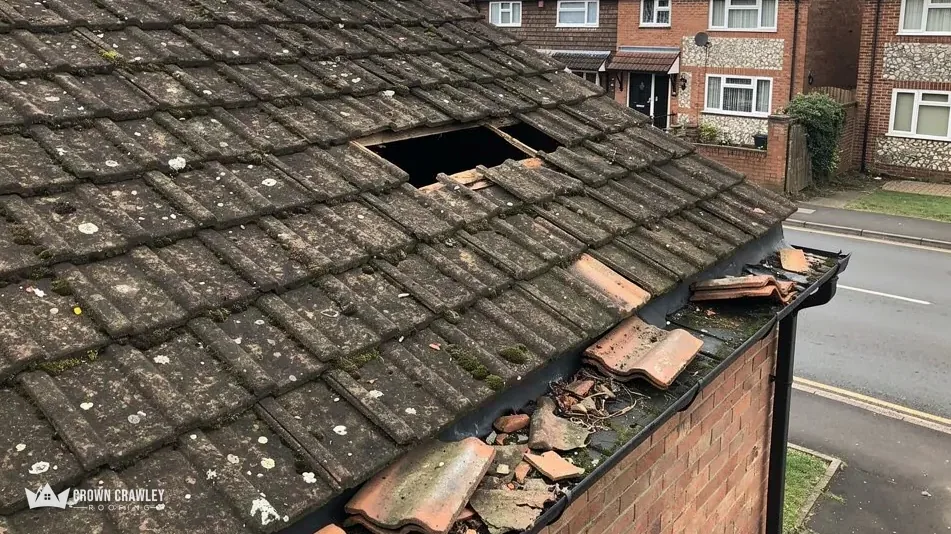
We begin at the kerb: a look along each slope for cracked or slipped tiles, a sight along the ridge for sag, a check of the valleys (the channels formed where two slopes meet) and a read of the chimney. If you can open the loft, we go up, because the underside of the slopes shows daylight, stains and the kind of underlay better than the outside ever will. Eaves and gutters come next, since a clogged gutter forces rainwater up under the bottom course of tiles. A chimney stack on the ridge line gets a close look at its pointing, its flaunching (the mortar cap) and its lead flashing, because those joints let water in long before a tile fails, and photographs of each go into your survey set. A flat-roofed extension, garage or porch is judged separately from the pitched roof, on its membrane and its falls, and the flat roofing page explains how.
Age is a rough guide only. Marley gives a concrete tile around 60 years with no guarantee attached, the Building Research Establishment sets 60 years as the minimum for clay, and the Confederation of Roofing Contractors says well-maintained slate can pass 100. Flat roofs run shorter: one cost guide gives felt 10 to 20 years and GRP 25 to 40, while a trade guide gives EPDM 20 to 30. A repair is right when the covering is sound and the fault is local, such as a loose tile, a cracked flashing or a ridge that has lifted. Replacement is right when nails, battens or underlay have failed across a whole slope. Our pitched roofing page lists the repairs we weigh, and the photographs from your own survey show where your roof stands between the two.

Stage 02 · Access
On a road-fronting house the scaffold may stand on the pavement, and Croydon has its own fees, bond and site visit for that.
Any scaffold that obstructs the pavement or carriageway needs a highway authority licence under section 169 of the Highways Act 1980. For Norbury the authority is Croydon council, and its published terms hold a few surprises.
Fees are quoted per elevation, meaning per side of the building: £488 for four weeks, or £610 for four weeks where that side runs past 10 metres. One month is the minimum term. A refundable bond of £50 per square metre of enclosed highway sits on top, renewals must reach the council at least 7 days before expiry, and no licence issues until an officer has visited the site. Silence is not consent, because deemed approval does not apply. The council's pages do not say who the applicant is, so we ask the scaffolder and arrange the paperwork with them. As a national yardstick, Checkatrade's roof replacement guide (October 2026) gives £700 to £1,300 for the scaffolding on a new roof, ahead of any Croydon fee, and our answer on scaffolding cost for a new roof goes through the other factors.
Croydon states that scaffolding on private land needs neither licence nor consent, though parking suspensions can still be required if a skip or delivery lorry needs the kerb. Front gardens on a main road can be shallow, so we measure at the survey and tell you early whether the poles fit on your side of the boundary or must stand on the pavement. Either way you receive the dates for putting up and taking down, and we keep the pavement as clear as the licence allows for people walking past with pushchairs and shopping.
Because Croydon issues nothing before a site visit and the term is a month at least, the licence is applied for first and the roof dates are fixed afterwards. That order stops a roof being left open to the weather while paperwork waits, and it means the start date you hear from us is one we can keep.
A scaffold on a main road is noticed by everyone who passes. We tell the houses either side before the poles arrive, agree where deliveries and skips will stand, and clear the pavement of dust and offcuts every evening. The licence sets conditions, and we plan the job so they are easy to meet.
Words on a Croydon licence page
Silence from the council never counts as a yes.
Stage 03 · Permissions
Croydon runs its own planning and building control. Three conservation areas and two Grade II listed buildings sit in or near Norbury.
Croydon has designated the Norbury Estate and Norwood Grove conservation areas, and Lambeth's Streatham Lodge Conservation Area sits just over the borough line, so check your street before any change to a roof's look. London adds one layer that West Sussex lacks, the Greater London Authority above the borough, but for a roof repair it is the borough's own teams you deal with.
Barclays Bank, listed on 15 February 1983, and Norbury Hall both hold Grade II. Statute forbids unauthorised works that would alter a listed building's special character, so consent comes first. Is your own house listed? Historic England runs a searchable online list of designated buildings, and Croydon's planners can confirm the answer. Listing protects the whole building, roof included, so even routine-looking work such as relaying the front slope deserves a call to the council first. If it is, consent is sought before any strip or change of covering, and the answer is attached to our written quote.
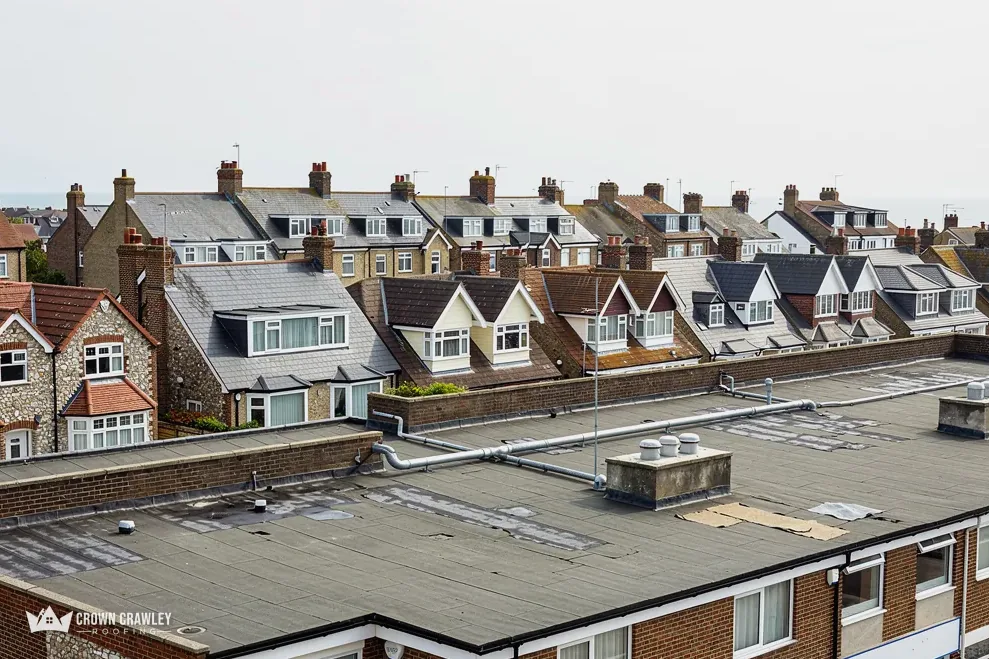
Points to inspect in Norbury
Building control here is Croydon's own service. Under the Planning Portal's yardsticks, a roof job usually escapes an application when under 25 per cent of the building envelope, and under 50 per cent of the roof, is touched by the job; a covering at least 15 per cent heavier, or one with a different fire performance, tips it the other way. Flat roofs on extensions follow Approved Document L, which counts a replacement waterproof layer as renovation and so raises the insulation question. On such a roof the choice between felt, EPDM and GRP also sets the insulation detail, which is why the covering is agreed with you well ahead of the written price. Our roof replacement service page takes a re-roof stage by stage.
It can. Houses near the northern edge of Norbury may sit on either side of a borough boundary, and the council tax bill shows which council your address belongs to. That council's planning and building control teams are the ones to ask. For a first look at your roof, photograph it from the road and from the back, add your postcode, and mention any flat-roofed extension, garage or porch so the survey is planned with it in mind. We note the borough at the top of the survey, so every later question goes to the right desk.
A ridge leak points to the bedding or fixings under the ridge tiles, which makes it a repair when the slopes below are sound. Marley says the 2014 revision of BS 5534 ruled out trusting mortar alone, so we fix a rebedded ridge mechanically, or fit a dry system. The survey checks the battens and underlay beneath before we price.
Under Croydon's list, £488 buys four weeks of scaffold or hoarding on one elevation, or £610 if that side exceeds 10 metres. The minimum term is a month, and a refundable bond of £50 per square metre of enclosed highway applies. Scaffold confined to private land is outside the licence. The survey tells you which applies, and we plan access around it.
Look up your address on Historic England's online list, or ask Croydon's planners. Barclays Bank and Norbury Hall are Grade II, but your street may hold others. A listed house needs the council's consent before a strip or a new covering. An unlisted one can have a like-for-like repair without it, and the survey confirms what the roof carries.
The roof from the road, the roof from the back garden, any ceiling stains, and the view from the loft hatch if you can get to it safely. Add your postcode and mention any flat-roofed extension. After the survey you receive pictures of our findings and one written total, so the reasoning behind the price is easy to follow.
Photograph the roof from the road and from the back, add your postcode and any flat-roofed extension, and we will book the survey.
Message us on WhatsApp