Roofers in Mitcham

Roofs in a Wandle-side village that spread around its commons.

Mitcham grew round its commons beside the River Wandle, known for physic gardens of lavender and roses. Tile, slate and lead each get read on the roof itself, then priced once in writing.

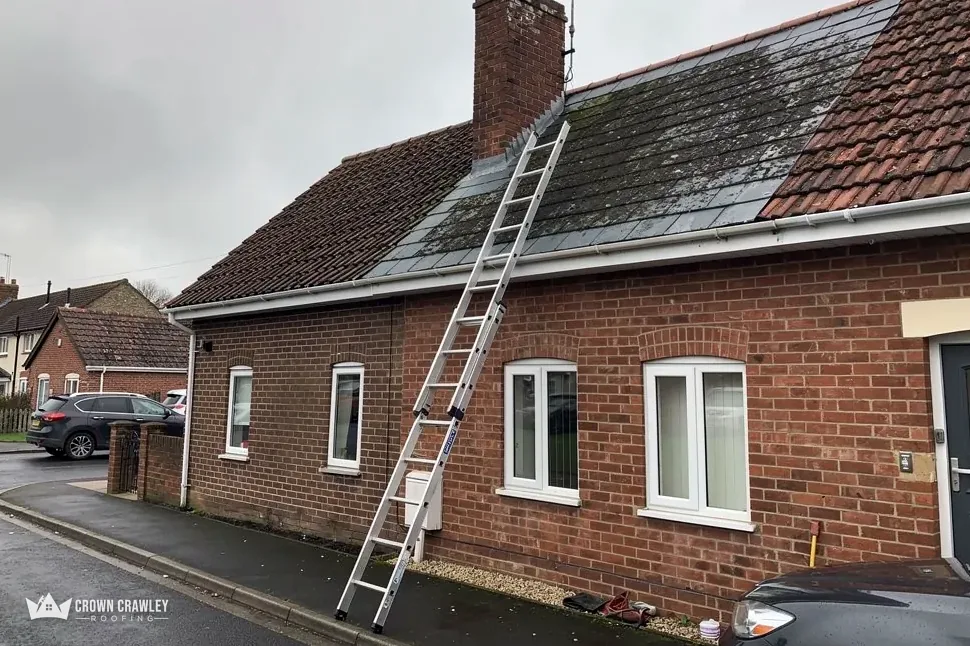
Brick bungalow with a ladder leaning against its tiled roof

What sits above Mitcham's commons and cottages

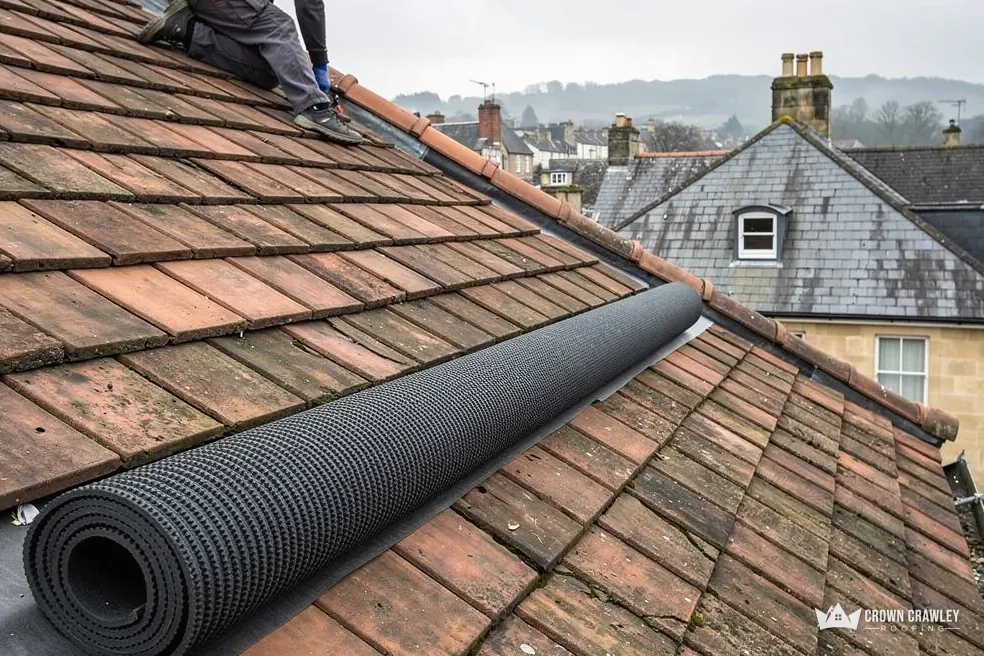
Roll of roofing membrane lying on a clay tiled roof

Weather-boarded cottages under tile

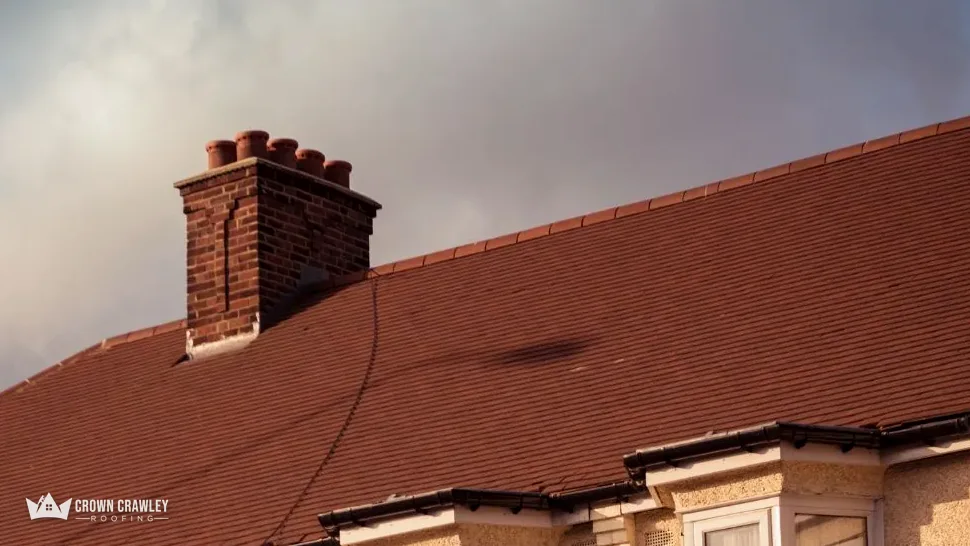
Writing in 1912, the Victoria County History found many old cottages timber-built and weather-boarded under tiled roofs. Where one survives, the roof and the boarding beneath it are checked as a pair.

Old tiled roof on a cottage

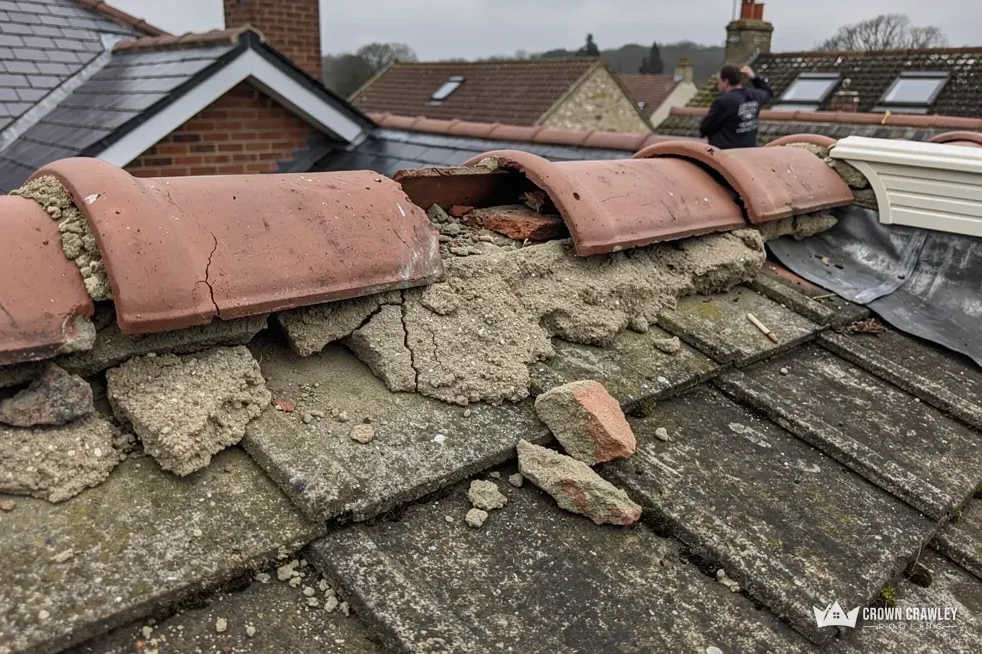
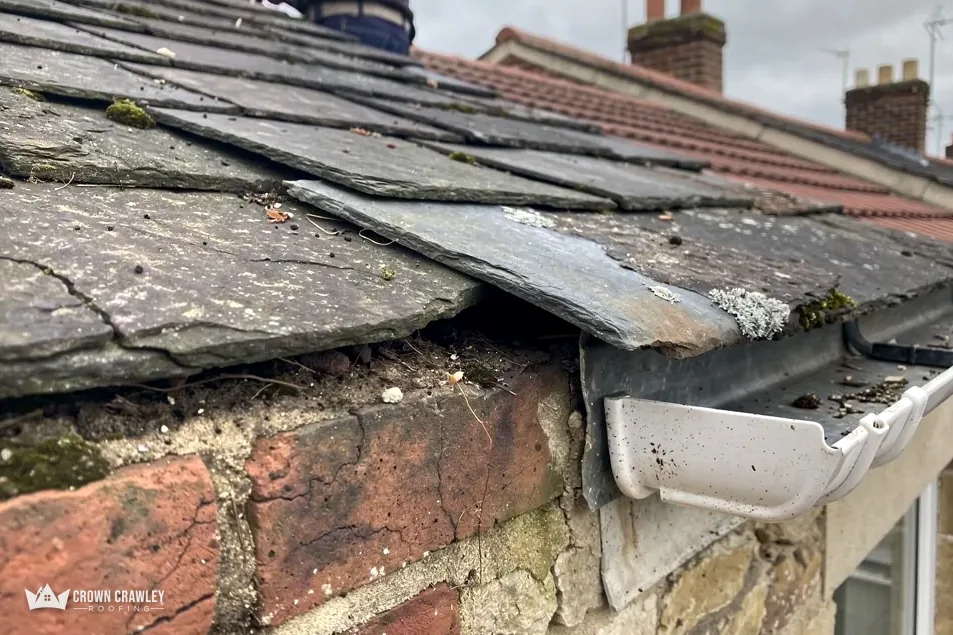
Crumbling mortar and cracked ridge tiles on a roof

Red brick cottages with tile

The same history mentions 18th-century red brick cottages with tile roofs, and others part brick, part timber. A roof on a building of that age is matched to its own tiles, not swapped for convenience.

Brick cottage with clay tiles

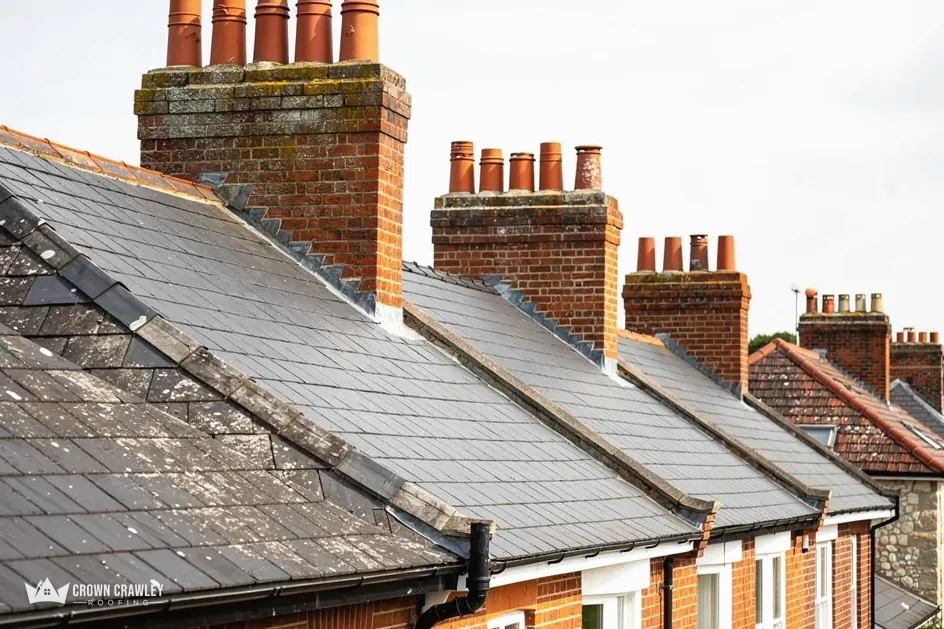
Row of terraced chimney stacks above slate roofs

Eagle House and its slate

Eagle House, dated 1705, had a hipped roof of purple slates finishing in a lead flat when the history described it in 1912. It is Grade I listed, and it shows why slate and lead earn their own survey.

Slate roof with a lead flat

Mitcham, beside the River Wandle

Map of Mitcham and the neighbourhoods around it, with Crawley for reference.

Mitcham is a low former village on the River Wandle, rarely above 90 ft, spread around its large commons, in the London Borough of Merton.

Distance
23.8 road miles from Crawley, to the north
Drive
About 42 minutes
Council
London Borough of Merton (London borough; Greater London Authority above)
Planning authority
London Borough of Merton
Eagle House
Grade I, list entry 1358013, listed 7 May 1954
109-111 London Road
Grade II, list entry 1193387
55 Upper Green East
Grade II, list entry 1080893
Get a free quote

Mitcham: what happens when

Reading roofs from lavender fields to lead flats

Three short chapters on how Mitcham's physic gardens and cottages frame its building stock, how slate, tile and lead age, and where Merton's approvals and scaffold terms come in.

Stage 01 · Background

Physic gardens and tiled cottages

Physic gardens were Mitcham's chief industry until about the 1850s, and its old cottages were timber-built under tiled roofs.

For generations Mitcham earned its living from physic gardens, growing roses, camomile, white poppies, liquorice, peppermint, angelica and lavender. The Victoria County History calls that its chief industry until about the 1850s, and says rose and lavender growing had stopped by 1912. The village spread in a straggling way around large commons, on low ground beside the Wandle. For a roofer the useful part is what the same history says about the buildings.

What were old Mitcham cottages roofed with?

Pictured in 1912, many old cottages were wholly timber, boarded on the outside and tiled above, with a number built partly in brick, and the history adds 18th-century cottages of red brick under tile. That describes the village over a century ago and says nothing certain about your street, so any cottage still standing is read as found. Wherever a tiled slope meets a boarded or brick wall, the junction decides whether rain stays out. Three parts matter: the flashing, a metal strip sealing the join, the gutter taking the run-off, and the eaves detail that keeps water off the boards.

Up close in Mitcham

Tiles
Colour, size and camber noted
Wall junctions
Flashings sealed along the join
Eaves
Rafter ends and boards probed
Gutters
Falls true, brackets firm
Flat roofs
Membrane, outlets and upstands
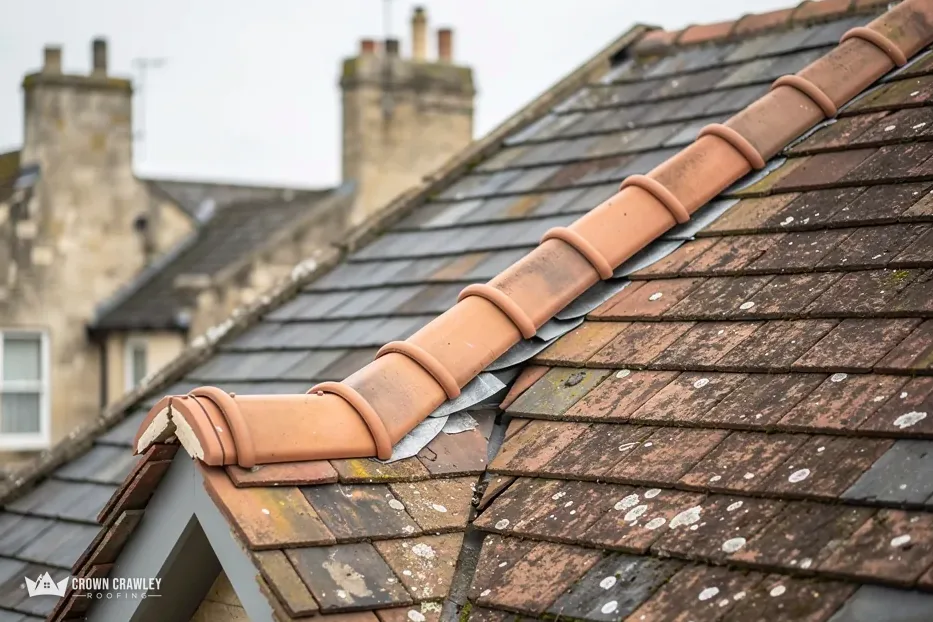
Clay ridge tiles along the hip of a weathered tiled roof

How do you mend an old tiled roof without spoiling it?

Matching comes first. We note each tile's colour, size, camber and texture and look for close partners among sound ones; tiles lifted from a back slope can repair a front slope when no new tile looks right. Handmade clay weathers differently from machine-made, so a clumsy patch shows. Clay is credited with at least 60 years in Building Research Establishment figures, while an article on building conservation warns that the figure misleads on old peg tile. Age therefore proves little; condition does, tile by tile and nail by nail. Our pitched roofing page explains how slipped or cracked tiles, battens and underlay are renewed while sound slopes stay put.

Damp at the eaves rots boarding before it shows indoors, so when we reach the edge of the roof we probe the wall plate and the ends of the rafters with a bradawl. A gutter that has leaked for years leaves its mark there first. Where the timber has gone soft, the plan changes, and you see photos of it before any figure is agreed.

A cottage with a tiled roof above weather-boarding has few places to hide a fault. Drips running down a board, green staining under a gutter joint and boards that give under a thumb each point back to something above. We trace every sign upward from the wall to the roof edge and then to the slope, so the repair lands where the water gets in rather than where it shows.

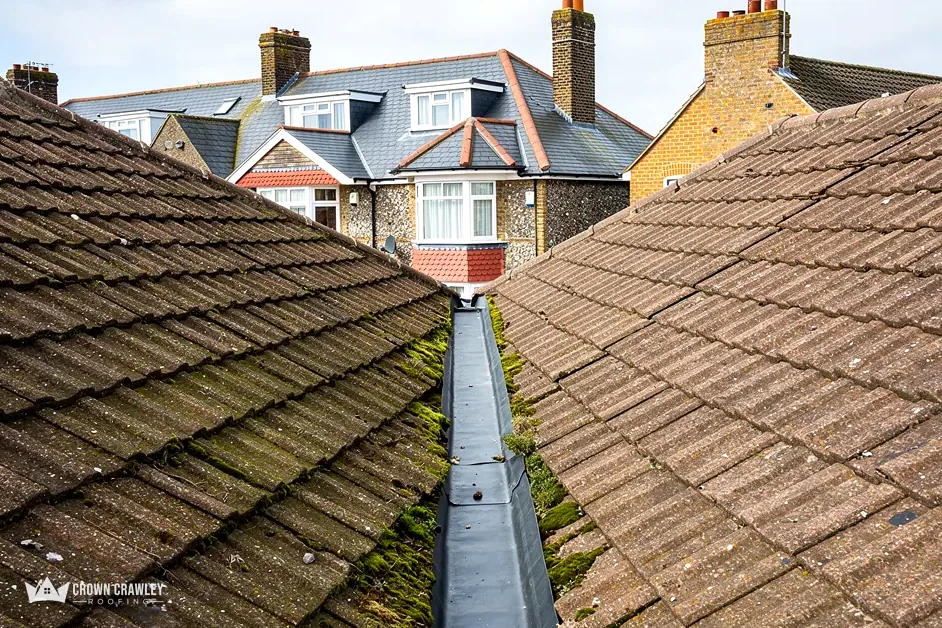
Lead-lined valley gutter between two tiled roof slopes

Stage 02 · Materials

Slate, lead and Eagle House

Eagle House, dated 1705, had purple slates and a lead flat in 1912, which makes it a useful lesson in how those materials age.

When the Victoria County History described Eagle House on the road to Tooting in 1912, it recorded the date 1705 on the rainwater heads, walls of stock brick with gauged brick dressings, and a hipped roof of purple slates finishing in a lead flat. Eagle House is listed Grade I (entry 1358013, first listed 7 May 1954). Two more Mitcham buildings, at 109-111 London Road and 55 Upper Green East, are listed Grade II. Planning data also places 55 Upper Green East inside the Mitcham Cricket Green conservation area.

How long do slate and lead last?

The Confederation of Roofing Contractors' figure for slate in good repair is 100+ years, and a cost guide puts lead flashing past 80 years. Both are typical figures, not promises. Slate tends to fail through its fixings, as nails corrode and slates slip. Under BS 5534 guidance, natural slate wants a pitch of at least 20 degrees, and hook fixings are for slopes of 25 degrees or steeper, so a shallow slope may need different fixings from a steep one. Lead fails where it works hardest: joints, steps and folds that have flexed with every winter. A re-fix or a patch frequently solves it, and the written price says whether it does or whether replacement is the better buy.

Lead and slate terms

Lead code
Number for sheet lead thickness
Soaker
Small lead piece beneath tiles
Hipped roof
Roof sloping down on every side
Box gutter
Lead-lined trough between roof slopes
Slate and lead can outlast tile, but only while their fixings and joints hold.

Which lead thickness goes where?

Sheet lead comes in codes. According to Royston Lead's brochure, Code 3 suits soakers only, Code 4 stretches to flashings and pitched valley gutters, and the heavier codes from 5 upward take on parapet and box gutters. Before ordering, we tell you which code we propose and why, so the metal matches the work. A Checkatrade guide dated June 2026 puts typical UK lead flashing repair at £50 to £70 per metre, and stepped flashing in Code 5 at £80 to £120 per metre. Those are national guide figures; your own total arrives in the written quote after the survey.

A Grade I building like Eagle House is a case for the council: repairs that alter its character go to Merton's planning team for listed building consent first. Our lead work page covers flashings, valleys and flats in more depth, including why lead run-off and white residue are worth a look.

Where a lead flat meets a wall, the upstand, which is the lead turned up the brickwork, and its flashing carry the weatherproofing. Tired fixings let lead slump, and slumped lead splits along its folds. Re-dressing it or welding in a patch can be a smaller job than relaying the whole flat, and the survey tells us which one your roof needs.

Stage 03 · Permissions

Merton approvals, flat roofs and nests

Merton is planning authority and building control body, and flat roofs, scaffold and nesting birds each bring their own checks.

Merton is a London borough, which means one council does the work a district and a county would split elsewhere, and the Greater London Authority is the layer above. Planning, building control and the roads all route through Merton, so most permission questions have one address.

Does recovering a flat roof in Mitcham need approval?

It can. Approved Document L (2021 edition) puts a new waterproof layer onto a flat roof within renovation work. When renovation covers more than half of an element's surface, that element is expected to meet the document's thermal values unless this is not technically or functionally feasible. Separately, the Planning Portal says a covering that adds 15 per cent or more to a roof's weight needs approval. So a garage or extension flat deserves a call to Merton's building control before a membrane is chosen. Our flat roofing page shows how a recovering is planned and priced as one written total.

Signs we look for in Mitcham

Planning
Merton's planning team
Approvals
Merton building control
Scaffold
Licence for road or pavement
Flat roofs
Energy values may apply
Nests
Active ones left alone
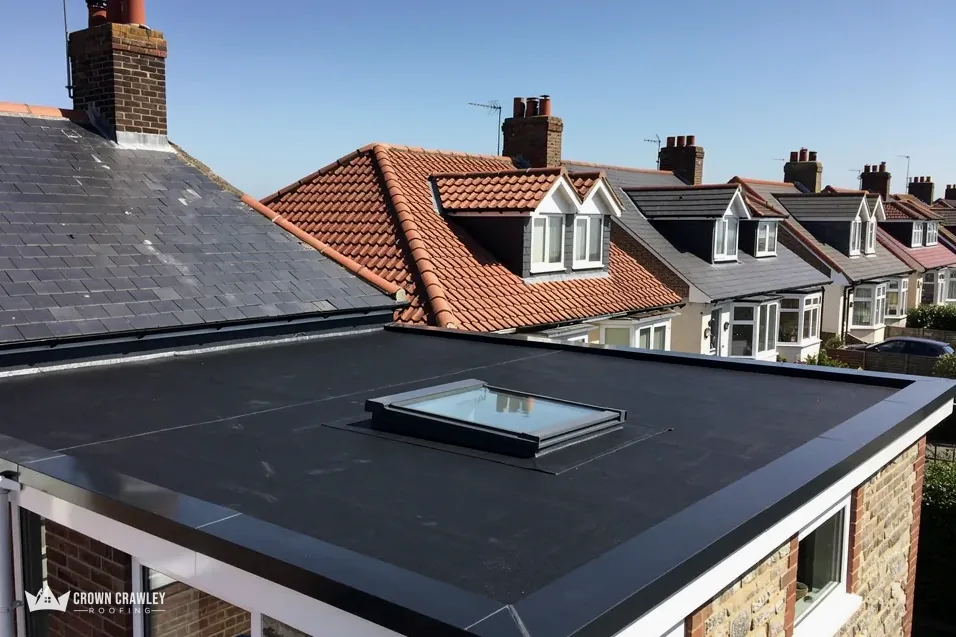
Black flat roof with a rooflight on a house extension

How does scaffold work on a Mitcham street?

Under section 169 of the Highways Act 1980 a scaffold on a road or footway needs the highway authority's licence beforehand. For Mitcham that is Merton, whose terms and charges are its own. Our habit is to ask the scaffolder who applies and for how long, and to promise no start date until the licence is in place. Poles standing entirely inside your boundary need nothing from the council, though a parked-car bay outside may still need arranging. When you compare quotes, check whether each one covers scaffolding and VAT. On a terrace or semi the access question comes early: where the poles can stand, how materials reach the roof, where waste is collected. We settle those at the survey, tell neighbours the dates and keep the pavement clear.

Can nesting birds delay a roof job?

They can. Under the Wildlife and Countryside Act, intentionally destroying or damaging a wild bird's nest during its use or construction is an offence, and government guidance confirms that no licence exists to allow building work to proceed over one. If the survey finds an active nest, the work is planned around it and you hear the earliest safe start, in writing, before any date is booked. To begin, photograph whichever tiles, slate or flat section puzzles you, and send the picture with your postcode attached.

Mitcham roof and approval queries

How does a weather-boarded Mitcham cottage affect roof repairs?

Mainly in what gets watched. Rain coming off a tiled slope can soak the boarding beneath it, so flashings, gutter and eaves are inspected together, and the ends of the timbers are probed for softness. The repair is otherwise the same as anywhere: matched tiles, sound battens and a sealed junction, all shown in photos before you agree anything.

Should the slate on an old Mitcham roof be kept?

Frequently it can be. A trade body figure puts slate in good repair at 100+ years, and the commonest faults are rusted nails and slipped slates, which a re-fix can cure, often leaving the sound slates in place. We measure the pitch against the 20 degree figure in BS 5534-based guidance, then tell you in writing whether repair or replacement makes better sense.

Is approval needed to re-cover a Mitcham flat roof?

Possibly. A new waterproof membrane counts as renovation under Approved Document L, and once more than half of the roof's surface is involved, as it can be on a garage or extension flat, energy values come into play unless they prove unfeasible. Merton's building control can advise on your own property, and our written figure reflects the council's answer.

Will a nest in my Mitcham eaves hold up the work?

It might. Intentionally damaging or destroying an occupied or half-built nest is an offence, so an active nest means the job is arranged around the birds. At the survey we check the eaves, soffits and gutter backs, tell you what we find and give you the earliest safe start in writing, so the dates you are given are ones that can hold.

Tell us what covers your Mitcham roof

Send a photo of the tiles, slate or flat section in question with your postcode, and a Mitcham survey date comes back to you.

01293 974253

10-year workmanship guarantee, in writing.

Call Get a free quote