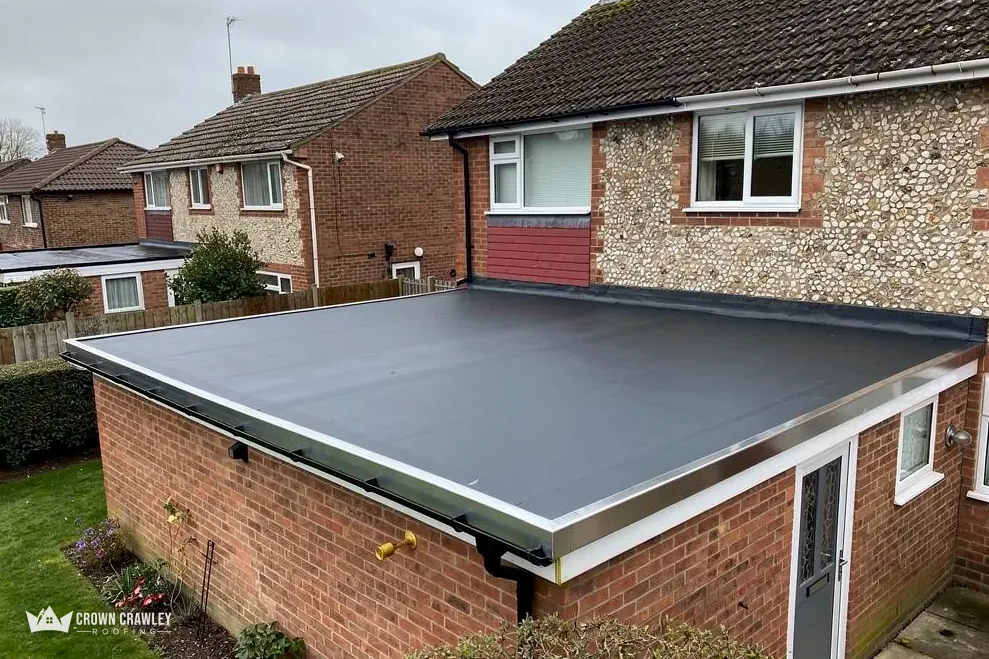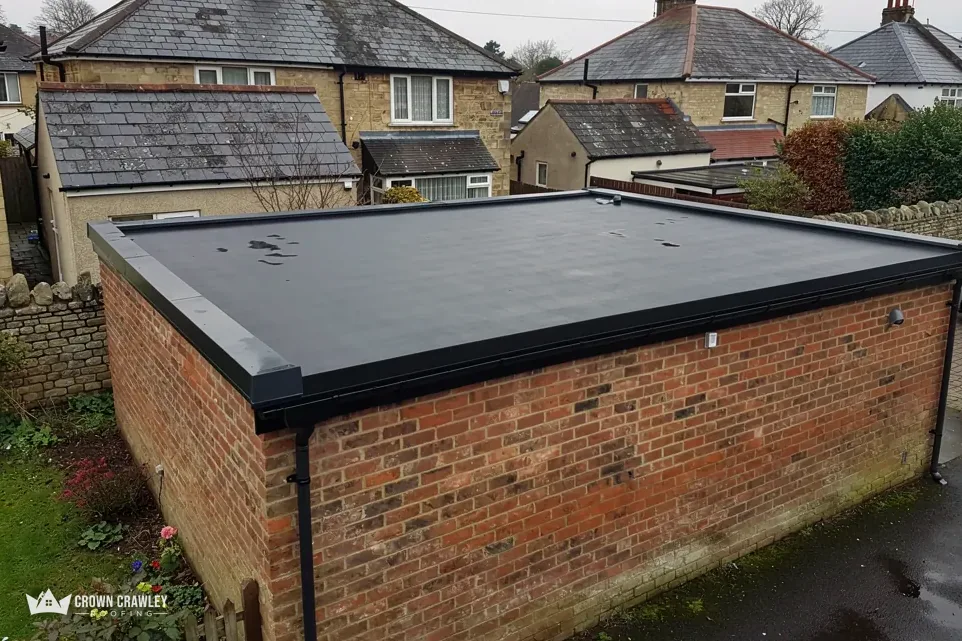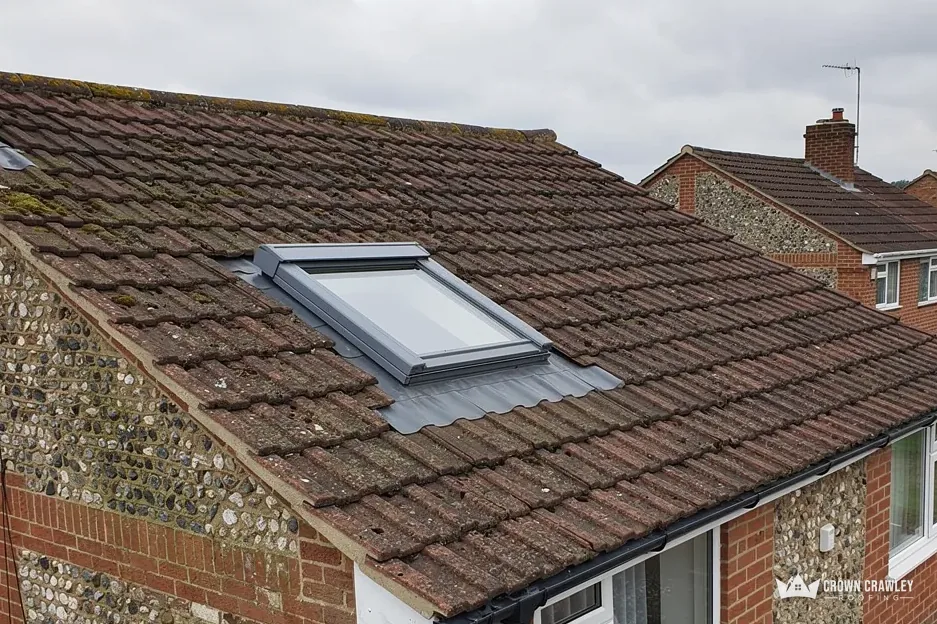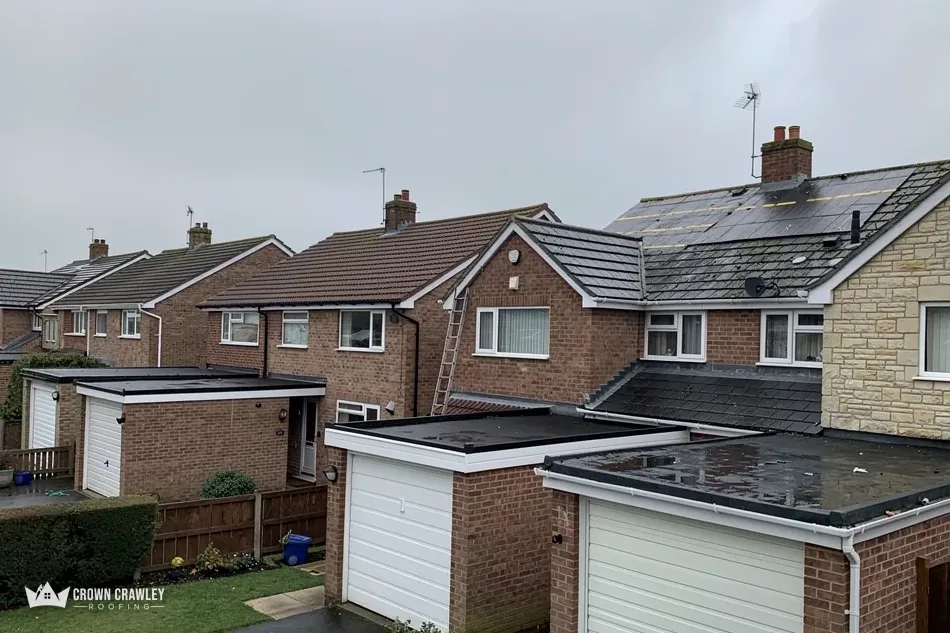
Search for a liquid rubber flat roof coating and you will find everything from a tin of paint-on sealant to a reinforced system laid by a trained team. They are sold under the same loose name, and they are not the same product. One is a cosmetic or maintenance coat that slows down the weathering of a sound roof. The other is a proper waterproof layer, built up in coats around a reinforcing sheet, which can act as the roof covering in its own right.
Knowing which one is being offered is the first job. This guide explains how liquid systems work, which roofs they suit, where they fail, what the surface needs before anything is applied and what to ask when someone quotes for one. It also notes how Building Regulations treat a new waterproof layer, because that point catches out owners who assume a coating is outside the rules. Throughout, the aim is to help you tell a good fit from a sales pitch.
What liquid roofing actually is
A liquid-applied roof is a waterproof layer that arrives as a fluid and cures into a continuous skin on site. It is brushed, rolled or sprayed over the existing surface, so there are no rolls to overlap and no seams to weld. Products come from many makers and use different chemistries, and the names on the tin vary, but the idea is the same: a coating that flows into corners and around fixings, then sets. Because the skin is formed in place, it takes the shape of the roof, bumps and all, and that is both its strength and its limit.
Cold liquid systems
The serious end of the market is the reinforced cold-applied system. The surface is cleaned and primed, a liquid resin goes on, a reinforcing fleece is bedded into the wet resin, and a second coat covers the fleece. The result behaves like a single sheet. Because it is cold-applied, no flame is needed, which is why these systems are chosen where a naked flame is a risk. Our page on flat roofing sets them beside the other coverings we fit.
Paint-on coatings
At the other end are single-coat or two-coat products, sold as roof paints or sealants. They are thin, they are not reinforced and they are meant to refresh a surface that is basically sound. They have a place in maintenance, such as renewing a tired but intact felt, but they do not rescue a roof that is already leaking through its structure. Treat any claim that one coat will cure a failed roof with caution. A fair test is to ask the firm what it will do if it finds wet insulation or soft boards underneath, and how that would change the price.
Liquid rubber is not the same as EPDM
The phrase liquid rubber causes a lot of confusion, because rubber roofing has another meaning. EPDM is a synthetic rubber sheet, supplied in a roll, cut to the roof and glued down or held with ballast. Liquid rubber is a coating that happens to share the word. The two behave differently, and prices, lifespans and fitting methods for one do not carry over to the other.
What do we know about lifespans?
For the sheet, GreenSpec lists EPDM at 20 to 30 years of service life. A single figure for liquid coatings would mislead, because the products vary so much between makers and between a paint-on coat and a reinforced system. Be sceptical of any single number offered for the whole category. The sensible question to put to the firm is what the specific product's data sheet says, which substrate it was tested on and what the cover on it requires of you.
Why does the difference matter for a quote?
Because a quote for a roll of EPDM and a quote for a roll-on coating are not like for like. They differ in how long the work takes, in what preparation is needed and in what the finished surface will tolerate. Ask each firm to name the product, the number of coats, whether a reinforcing layer is included and how the edges and outlets are treated. That tells you which of the two you are being sold, whatever the word on the leaflet. A written description of the build-up, coat by coat, is easy for an honest firm to supply.
Where liquid systems work well
Liquid systems earn their place on roofs where a sheet would be hard to fit. The common thread is shape: wherever the roof has lots of corners, penetrations or odd junctions, a material that flows to fit has a clear advantage.
Complex details
Round pipes, rooflight kerbs, steps, upstands with awkward returns and small areas cut by fixings are all easier with a liquid than with a cut sheet. There are no joints to line up around a vent pipe, so the number of places a seam can fail goes down. Many roofers use liquid even on a sheet roof for the details alone, laying the main area in one material and finishing the junctions in another that is compatible with it.
Overlays on a sound roof
A liquid system can go over an existing covering that is firm, dry and well stuck down, avoiding the cost and waste of stripping. That suits a roof where the deck is sound and the old covering has simply aged. It is also used where stripping is awkward, for example on a roof above a space that cannot be opened up. Whether it is the right choice turns on the layers beneath, which only a survey can reveal.
Small repairs
For a patch or a short length of failed upstand, a liquid repair can be formed neatly, with reinforcement for strength. Used like this it is a repair method, and should be quoted and described as one. A repair patch should also be dated and photographed, so that the next person who works on the roof can see what was done and where.
Where liquid systems fail
Most failures come from one of four causes, and all of them are about the surface under the coating rather than the coating itself.
Damp trapped underneath
A liquid coating forms a continuous skin, so any moisture in the layers below has nowhere to go. If the existing roof is wet, the water can push the skin up into blisters as the weather warms. A roof with a damp insulation layer, or one that already leaks into the deck, should be opened up, not sealed over. Trapped damp is the usual root of those blisters.
Poor preparation
A coating can only grip what it is stuck to. Dirt, moss, loose chippings, old flaking paint, grease and algae all stop adhesion, so cleaning and priming are the bulk of the job. If the surface has been skipped over, the coat may look fine for a season, then lift in sheets. A roofer who spends little time on preparation is a warning sign.
Ponding and structural movement
A coating does not change the shape of the roof. Standing water will find the weak points of any skin, and a roof that sags or moves at its joints will crack a rigid coating along the same lines. If the roof has no fall, it needs a fall first, and the usual answer is described in our guide to ponding water on a flat roof.
Weather at application
Liquid products need dry surfaces and suitable temperatures to cure. Work laid in the wrong conditions can fail early without anyone noticing at the time. Check the data sheet for the product's limits. Early morning dew, an overnight shower or a cold snap soon after laying can all spoil a coat that looked fine when the team left, so a firm that watches the forecast is worth more than one that works to a fixed date.
Preparing the surface before anything is applied
Preparation decides whether a liquid roof lasts. A good one begins with a survey, and the survey begins with finding out what is under the existing surface.
What is the roof made of now?
A liquid system has to be compatible with what it covers. Some products stick well to bitumen felt and others need a primer, and some existing coverings should not be covered at all. The roofer needs to know the covering, the number of layers, the state of the deck and whether the roof is insulated. Asking for a small test area is reasonable, and a firm that offers one is showing care.
How are the details dealt with?
Outlets, edges and upstands are cleaned, repaired and primed before the main area is coated. Loose or blown areas of the old covering are cut out and made good. Hollows that hold water are noted and, if they are deep, they are discussed with you rather than quietly filled. At the edges the coating runs up onto walls and over trims, forming a continuous skin that meets the next component without a gap.
Who checks the finished roof?
A roofer should walk you through the finished work with photographs, show the thickness achieved if the product calls for it and give you the data sheet for the system used. The paperwork matters because it tells the next owner what the roof is. Keep it with your house documents, and with any building control paperwork for the same roof.
Building Regulations, cost and what to ask
Owners often assume a coating is not roof work. A coating can still count as roof work under the regulations, because the tests look at how much of the building is affected and how the new surface performs, and not at how the product is sold. Whether a particular liquid overlay is treated as new waterproofing is for building control to decide, so ask them first, in writing, ahead of signing. Our guide to Building Regulations for flat roofs sets out the tests and the thermal upgrade that can follow.
How is a liquid roof priced?
No national price per square metre is a reliable guide for liquid systems, because the cost moves with the system, the preparation, the number of details and how much of the old covering has to be dealt with first. For context, Checkatrade's September 2026 guides give EPDM at £80 to £100 per m² and felt at £50 to £80 per m², and those are national ranges for other coverings. Once the survey is done, you receive a single sum in writing.
Which questions should you put to any firm?
Ask which product, which data sheet and how many coats. Ask whether the system is reinforced, what the existing surface is and how it will be cleaned and primed. Ask what happens at outlets and edges, what happens if damp is found and what cover comes with the product and with the labour. Our guide to repairing or replacing a flat roof helps you judge whether an overlay or a new roof is the sounder choice. To get a proper opinion, send us photos of the roof surface, the edges and any ceiling stains, plus anything you know about earlier coatings.
Part of our Flat Roofing in Crawley
Liquid roofing questions
Can liquid roofing go straight over an old felt roof?
It can, if the felt is dry, firm and well stuck down, and the product is compatible with it. Blistered, wet or loose felt should be repaired or removed first, because a continuous coating traps whatever is underneath. Your survey should confirm the existing layers before a product is chosen.
Is a paint-on roof coating a proper fix for a leak?
Usually not. A thin coating can refresh a sound surface, but it does not close a structural gap, cure a roof with no fall or dry a wet deck. If the roof is already leaking, find the cause first, then decide between a local repair and a reinforced system.
Does liquid roofing need a particular time of year?
Liquid products need a dry surface and suitable conditions to cure, so they are not suited to wet or very cold days. The product data sheet sets the limits. A sensible firm will move the date rather than lay a coat in poor weather, and will tell you why.