A roof leak has a cause, and the cause is almost always one of a short list. A tile has slipped, a ridge has loosened, a strip of flashing has lifted, a valley has split, a flat roof has opened at a seam, or a gutter has overflowed into the wall. Each shows itself in a different way, and each is mended in a different way, at a different cost. Knowing which one you are dealing with changes the conversation with a roofer. It also tells you whether the problem is urgent or can wait for a dry week.
Below, the repair types are set out one at a time: what you can see, what the fix involves and a typical UK cost band where a national guide gives one. The bands come from Checkatrade's cost guides. They describe the UK market, and none is a Crown price. Each is dated on the page, and several are quoted before VAT. If you want a summary first, the table in the next section lays the six types side by side. After that, each type gets its own section, and the last section covers how to judge whether a patch will do or a larger job is the better buy.
The six repair types side by side
This table gives the headline for each type. Every figure is a typical UK range from a dated national guide, not a quote for any particular roof, and the notes below the table say which guide each one came from.
| Repair type | Signs you may see | Usual fix | Typical UK band |
|---|---|---|---|
| Slipped or broken tiles | Gaps on the slope, tile pieces in the garden | Replace or refix the tiles | £170 to £500 for up to five tiles |
| Ridge and hip tiles | Cracked mortar, loose or missing tiles on the top line | Rebed or fit a dry system | £50 to £70 per m for dry ridge |
| Flashing and lead | Stains on a chimney breast, damp beside a wall | Renew or redress the lead | £50 to £70 per m |
| Valleys | Stain along the line where two slopes meet | Renew the lining or lead | Set by the survey |
| Flat roofs | Ponding, blisters, a split seam | Patch or recover | £100 to £180 per m² for repairs |
| Gutters and fascias | Overflow, drips, green staining on the wall | Refix, clear or replace | £650 to £1,700 to replace |
Which guides do those figures come from?
Slipped tiles come from Checkatrade's roof tile replacement guide, October 2026 table. Ridge, flashing and flat roof repair figures come from Checkatrade's roof repair cost guide, June 2026 table, where costs are before VAT. The gutter figure is Checkatrade's October 2026 gutter replacement guide, for about 15 to 20 metres with three downpipes. Where the table says the survey sets the cost, no national figure is available to quote, and we would rather say so than guess.
Slipped, cracked and missing tiles
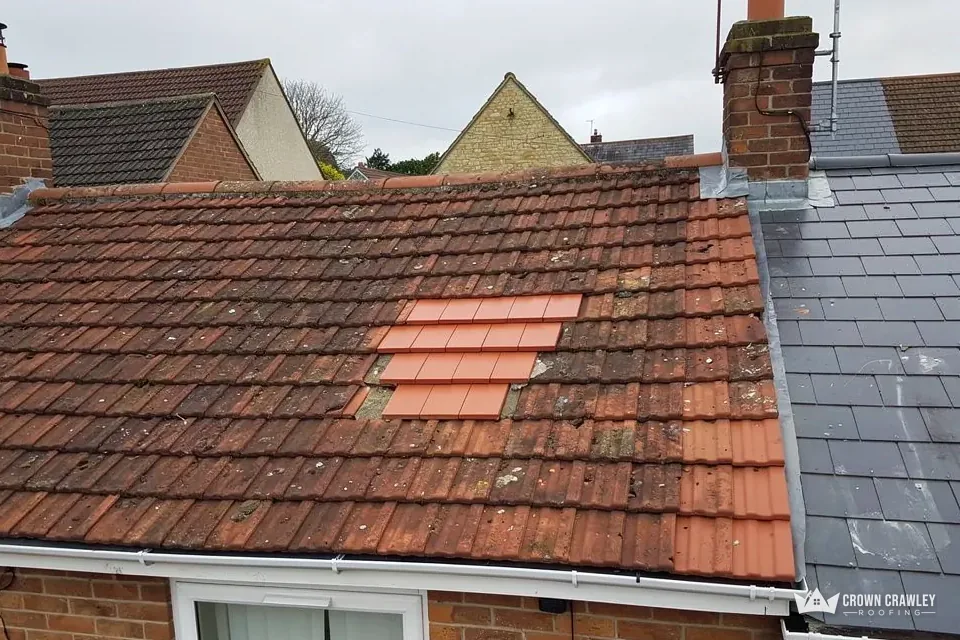
This is the most familiar repair on a pitched roof. A tile is a small part of a large surface, so one failure can look minor, but water does not care how small the gap is.
What are the signs?
From the garden, a dark patch or a break in the pattern of the courses is the giveaway. Pieces of tile on the path or in the gutter are another. Inside, a stain that spreads after rain, or a drip into the loft insulation, can point to the same place. Stay on the ground or in the loft when you check. Walking over tiles to see closer is how people get hurt, and it breaks more of them.
What is the usual fix?
The roofer lifts the tiles around the gap, replaces the broken one with a matching tile or a good reclaimed one, and refixes any that have slipped. Where nails or clips have corroded, or the timber under the tile has softened, the work reaches those parts too. Our article on roof tiles blown off covers what to do straight after a windy night.
What does it cost?
Checkatrade's roof tile replacement guide, in its October 2026 table, gives between £170 and £500 for up to five roof tiles. The lower end is a simple replacement. A higher figure covers work needing a ladder and bedding, and the top of the range includes scaffold. Access is the swing factor, which is why a roofer needs to see the position of the damage before quoting. Should tiles keep dropping at one spot, suspect the timber underneath rather than the tiles, and expect a bigger job.
Ridge and hip repairs
The ridge runs along the top of the roof where the two slopes meet, and hips run down the corners. Both are finished with curved or angled tiles that take the worst of the wind.
What are the signs?
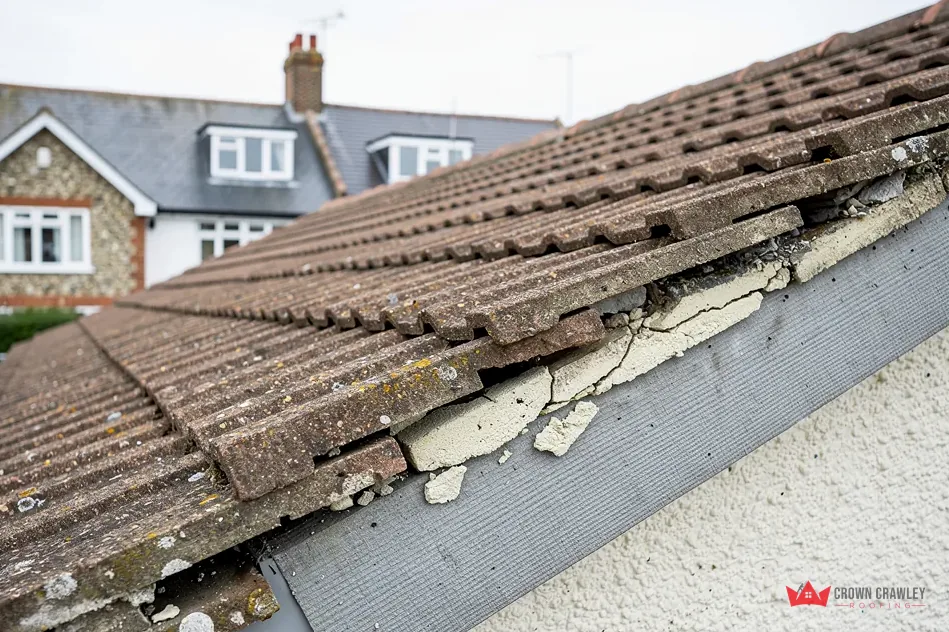
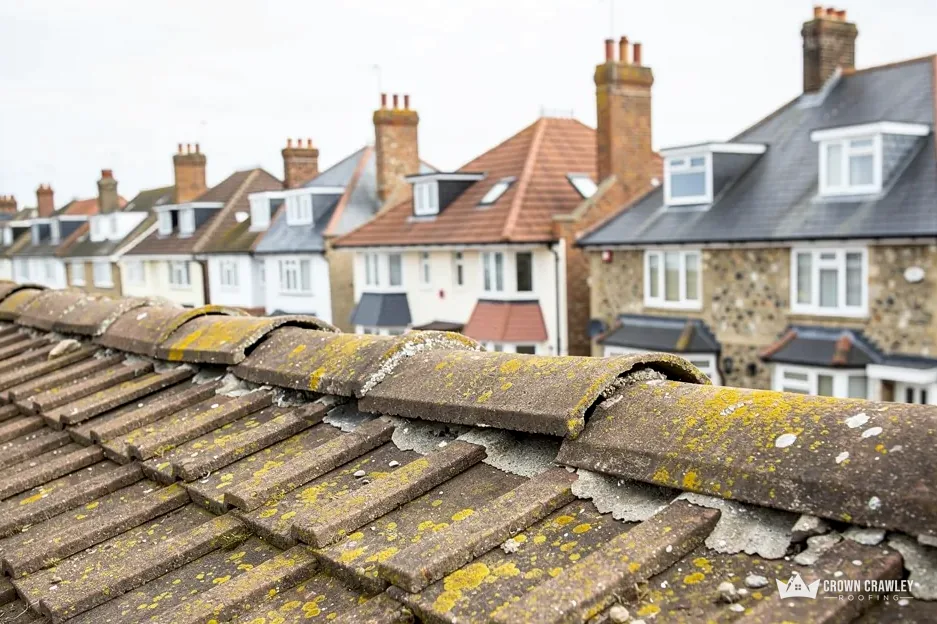
Look for lines of cracked or crumbling mortar under the ridge tiles, a tile that sits at an angle, or a gap in the line against the sky. A ridge tile that has fallen can slide down the slope and hit the gutter or a path. After a storm, check the garden for pieces.
What is the usual fix?
When the ridge tiles themselves are undamaged and just the mortar has gone, the roofer takes them off and rebeds them with fresh mortar and a mechanical fixing, or replaces the whole run with a dry-fixed system. A dry system holds each tile with clips or screws on a batten and needs no mortar. Our guide to the dry ridge system shows the parts.
What does it cost?
Checkatrade's June 2026 table for roof repairs gives dry ridge repair at £50 to £70 per metre and dry hip repair at £70 to £100 per metre. A bedded ridge is usually cheaper per metre to mend but needs mending again sooner, in the way that mortar always does. Add scaffold if the ridge cannot be reached safely from a tower, and check whether any quote includes VAT. A short ridge can cost less than the access it needs, so ask how the roofer plans to reach it.
Flashing, lead and chimney junctions
Flashing is the strip of metal, usually lead, that seals the joint between a roof and anything that rises through it or stands against it: a chimney, a wall, a dormer or a roof window. These joints leak more often than flat tiled areas, because two different materials meet and move at different rates.
What are the signs?
Damp patches on a chimney breast inside the house, brown staining on the wall next to the roof, and a drip that only appears in driving rain from one direction all suggest a flashing fault. Outside, lead that has lifted at an edge, split along a fold, or been pulled away by a sagging mortar fillet is easy to spot with binoculars.
What is the usual fix?
Small faults can be redressed, which means the lead is pushed back and re-fixed, and the joint resealed or repointed. Where the lead has cracked, it is replaced in sections, with new soakers where the roof tiles meet a wall. Sometimes the cause is the chimney, not the lead: a crumbling flaunching, which is the mortar slope on top of the stack, lets water in from above. Our pages on lead work and chimney repairs give more detail.
What does it cost?
Checkatrade's June 2026 table gives lead flashing repair at £50 to £70 per metre and stepped flashing at £80 to £120 per metre, using Code 5 lead. Its chimney repair guide, from April 2026, puts chimney flashing at £250 to £1,000. Scaffold, if needed, is extra. The range is wide because a short, easily reached run is a different job from a stepped run on a gable chimney.
Valleys and flat roofs
These two are grouped because both shed a lot of water through a narrow channel or a sealed surface, so a small defect has an outsized effect.
How do valley faults show up?
A valley is the inward fold in the roof where two slopes run down into one channel. It is lined with lead, a GRP trough or a metal liner, and tiles are cut to sit on either side of it. A stain running down a ceiling below the line of the valley, tiles that have slipped along its edge, or a lining that is split or choked with moss and leaves are the signs. The fix is to lift the tiles beside the valley and renew the lining, then relay the tiles. No national price figure is available to quote, so the survey sets it.
How do flat roof faults show up?
A flat roof fails at its seams, its edges and where water pools. You may see standing water a day after rain, blisters in the surface, or a split along a joint. Inside, a stain in the ceiling often appears some distance from the actual hole, because water travels along the deck before it drops.
What is the usual fix, and what does it cost?
A localised split or blister can be cut out and patched, but a surface that is tired across its whole area is better recovered. Checkatrade's roof repair guide, June 2026 table, gives repair costs per square metre before VAT, for up to 3 m²: £100 to £140 for bitumen, £120 to £170 for EPDM and £130 to £180 for GRP. Our emergency flat roof repair page covers the quick fix, and the flat roofing page covers a full recovering.
Gutters, and the patch or replace call
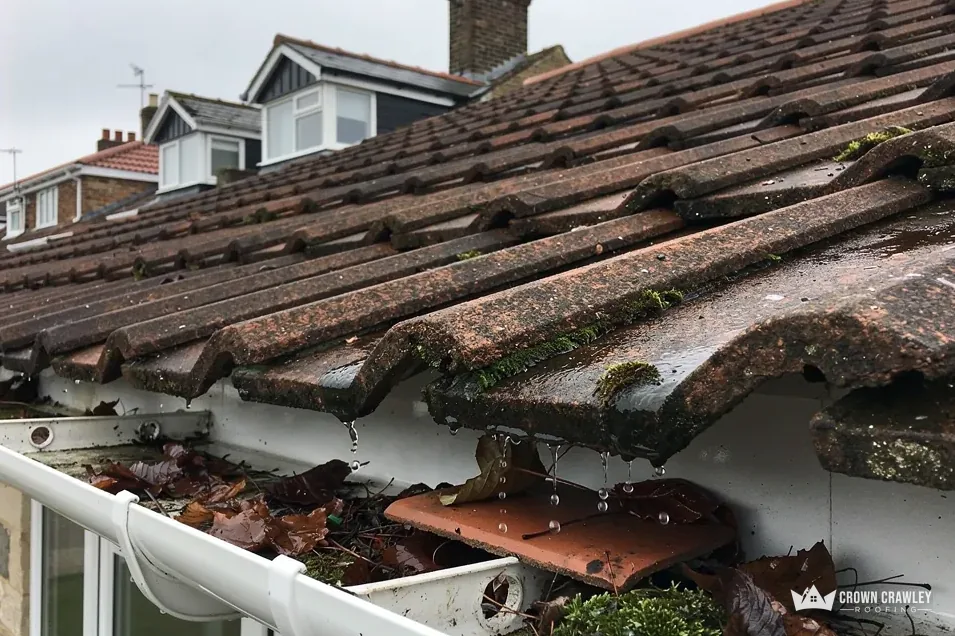
Gutters are the last item on the matrix, although they are often the first fault noticed, because the signs are right in front of you: water spilling over the front on a wet day, drips from a joint, green stains down the wall, or a gutter that sags between its brackets.
What is the usual fix?
Blocked gutters are cleared. Loose ones are refixed with new brackets, and leaking joints are resealed. When a run is cracked, warped or lacks the fall it needs to carry water to the downpipe, replacement is the better answer. Checkatrade's October 2026 guide puts gutter replacement at £650 to £1,700, averaging £1,000, for 15 to 20 metres with three downpipes. Fascias and soffits that have rotted behind the gutter are replaced at the same visit, since taking the gutter off once is cheaper than twice.
Is a patch ever the better buy?
A patch makes sense when the damage is confined, the roof around it is in good order and the cause is understood. It stops making sense when the same area fails twice, the battens or the underlay are soft, or the covering is tired across the slope. Then you are paying for repeated call-outs, and the better buy is a larger job. Checkatrade's June 2026 table gives roofer day rates of £35 to £45 per hour or £280 to £360 per day, a useful yardstick for how much a patch should involve.
If you are not sure which type you have, our guide to finding where a roof is leaking walks through the checks. When a roof is leaking now, the first job is to make it safe, and the emergency roof repairs page explains how we go about that. Send us photos of the damage, taken from the lawn or the loft, and after the survey you get one total price in writing.
Part of our Emergency & General Roof Repairs in Crawley
Roof repair questions
How can I tell which type of repair my roof needs?
Start with where the water shows. A stain below the ridge points up there, one beside a chimney points to flashing, and a stain under a flat roof points to the membrane. A roofer then confirms it from the roof. Photos from the ground or loft help.
How long should a roof repair hold?
No honest roofer can promise a number of years, because it depends on what caused the fault and how sound the surrounding roof is. A repair to a sound slope with a clear cause can last a long time. Ask what the roofer expects and what would make it fail.
Should I repair a roof that is already old?
When one spot is at fault and the covering around it is sound, a repair is reasonable. If tiles are crumbling or battens are soft across a whole slope, ask for both options priced as one total each, so you can see whether replacing is the better buy.