We all tend to look straight up at the stain and assume the hole is directly above it. It rarely is. Water runs along the top of the underlay, down the side of a rafter or across a ceiling board before it finally drips, so the wet patch in your bedroom can sit a metre or more from the spot where the rain gets in. That gap is why guessing leads to the wrong repair, and the wrong repair means the leak comes back the next time it blows from the same direction.
A roofer treats a leak like a detective job. We start with what the house tells us: the age of the roof, the weather when the water appeared, and the path inside. Then we work outwards, checking the usual weak points for that kind of roof before reaching for a hose. This guide sets out that order of work. It covers where water travels, the entry points on pitched, flat and lead-lined roofs, how a controlled water test is run, and what a moisture meter can and cannot tell you. You will see what you can safely check yourself, and what to photograph for the roofer.
Why the ceiling stain misleads
Water follows the easiest downhill route, and on a pitched roof that route is hidden. A tile or slate sheds most rain, and the underlay below it catches the rest and carries it to the gutter. If a tile cracks, a little water lands on the underlay, runs down it until it meets a batten or a lap, and then drips onto the rafter or the loft floor. From there it can travel along timber for some distance before it reaches a ceiling.
What does the timing of the leak tell you?
Note when the water appears. A drip that starts within minutes of heavy rain points to a direct opening, such as a missing tile, a split flashing or a blocked outlet on a flat roof. A stain that only grows after several wet days suggests slow seepage into insulation or timber, which then releases the water late. A leak that shows only when the wind comes from one quarter usually means wind-driven rain is being pushed under a loose or lifted covering on that side.
What should you note before the roofer arrives?
Write down the room, the wall it is nearest to, the weather at the time and whether the water is clear or brown. Brown water has picked up dirt or rust on the way. Take photographs of the ceiling and, if the loft is safe to enter, of the timbers above it. A phone torch and a clear view of the underside of the slope are enough. Keep to the loft boards or the joists, and never step on the ceiling between them. The more precisely you can describe the first appearance, the faster a roofer can narrow the search, and our guide on telling condensation from a roof leak helps rule out the other common cause of damp.
Common entry points on a pitched roof
On a tiled or slated roof, leaks cluster in the places where the plain sheet of tiles is interrupted. A roofer checks these first, usually from a ladder or a safe working platform, because the tiles themselves are seldom the problem on a roof in reasonable order.
Chimneys, valleys and abutments
Flashing is the metal strip, normally lead, sealing the joint between roof covering and a brick wall or stack. Where it lifts, cracks or loses its pointing, water gets behind it. Around a chimney there is also the flaunching, the sloping mortar on top of the stack that holds the pots, and the stack itself, whose brickwork can soak up and pass on water. A valley is the sunken channel formed at the meeting line of two slopes, and in a storm it collects runoff from both sides. A cracked valley liner or a valley choked with moss and leaves overflows sideways under the tiles.
Ridges, hips, verges and broken tiles
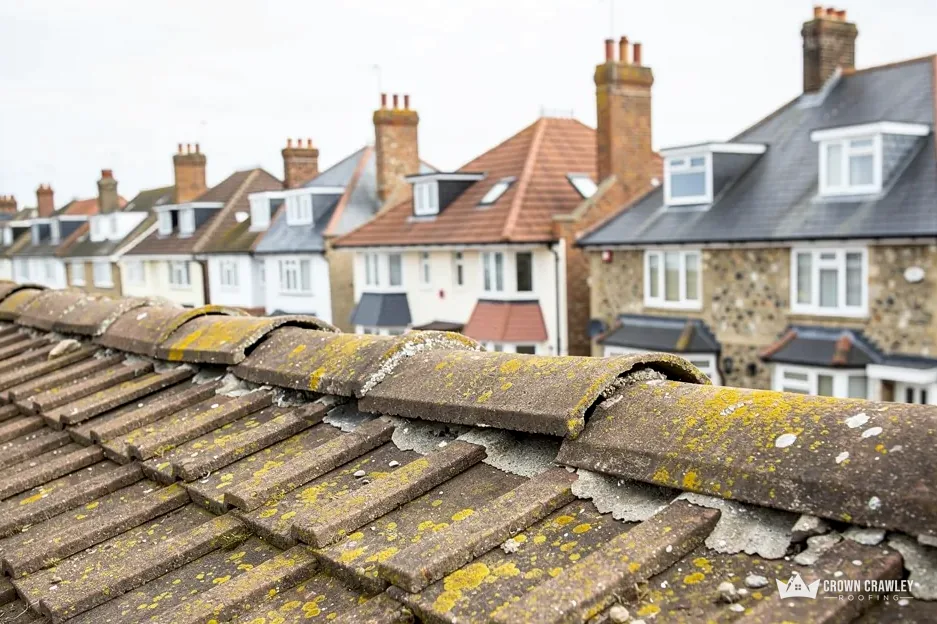
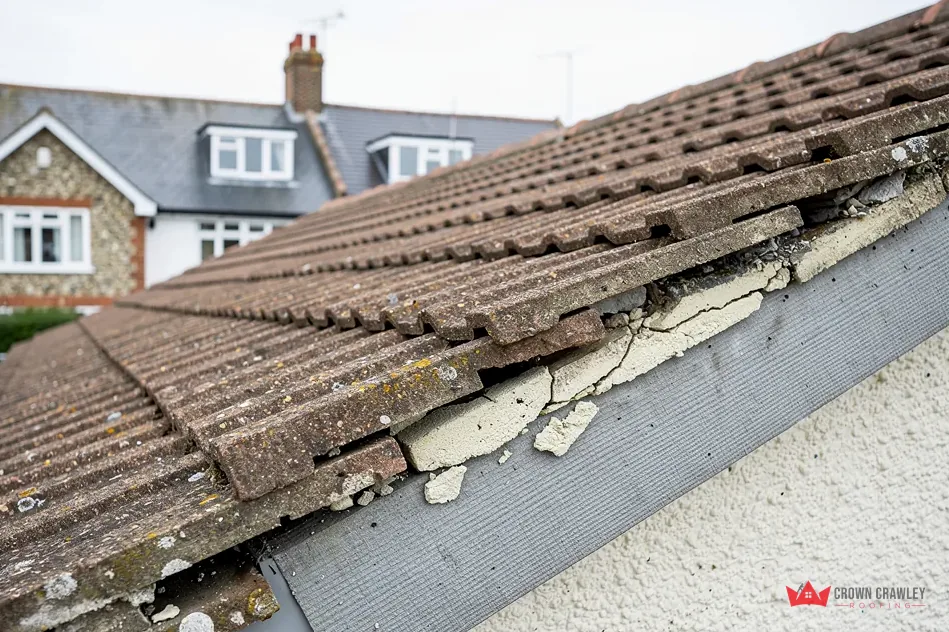
The ridge caps the very top, a hip slants down each projecting corner, and the verge finishes the roof where it stops at a gable wall. Older versions of all three sit on mortar, which cracks and drops out with age. Where a dry-fix system is fitted, the clips and seals can be damaged by wind. A slipped, cracked or missing tile exposes the underlay directly. Finally, check what lies under the covering. Underlay that has split or perished near the eaves, or a batten that has rotted, will let water through even when the tiles above look sound. Our page on tiles blown off in a storm shows what that damage looks like.
Where flat roofs and gutters let water in
A flat roof has no slope to shed water quickly, so every joint is a possible entry. The covering is one continuous membrane, such as felt, EPDM rubber or GRP fibreglass, and leaks tend to start where that membrane is interrupted or where water has been allowed to sit.
What do roofers check on a flat roof?
We look at the upstands, the short upturned strips where the membrane climbs the adjoining brickwork, and at the edge trims, the laps and seams, and the roof outlets. A blocked outlet leaves a pool, and ponded water finds the smallest split. Blisters in felt, cracks along a seam and a membrane that has lifted at a corner are all signs. A flat roof must also fall slightly toward its outlet. BS 6229:2025 keeps a minimum finished fall of 1:80 on open areas and inside internal gutters, so a roof that holds water for days after rain may have lost its fall or been laid flatter than it should be.
Gutters, downpipes and concrete gutters
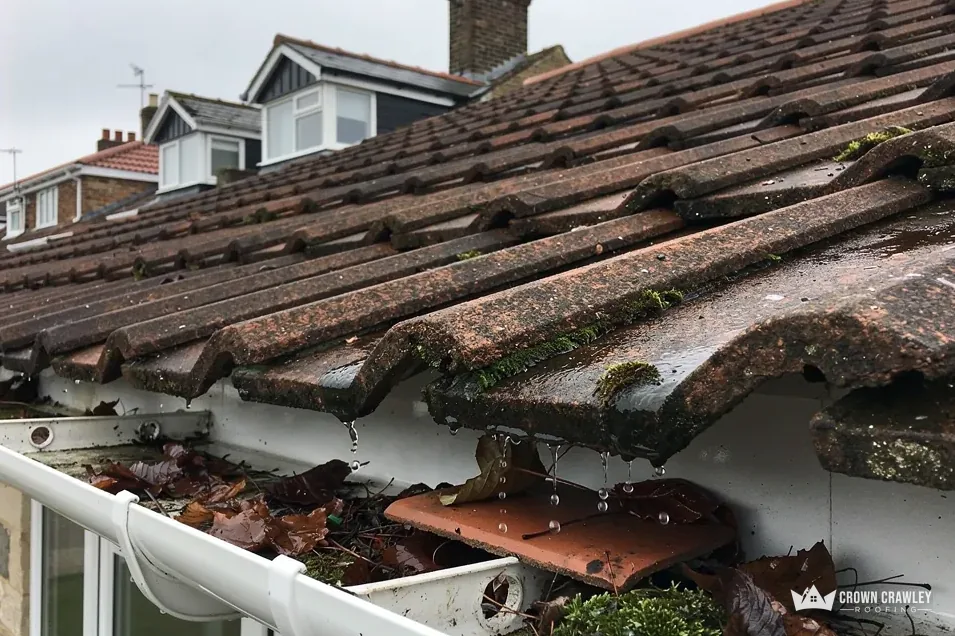
Not every ceiling stain comes from the roof surface. An overflowing gutter can push water back behind the fascia and into the eaves, and a leaking joint in a gutter can wet the wall below. Some houses from the 1950s have concrete gutters of the Finlock type built into the eaves. The RICS defects record links leaking Finlock joints to serious deterioration in many cases, and still warns against assuming every one must come out. A roofer therefore checks the joints before recommending anything large. A roof window can leak too, usually at its flashing kit or seal,.
How a water test works
When the visual check finds several possible entry points, the roofer separates them with a water test. The idea is simple: wet one small area at a time, from the bottom up, and see what happens inside. It needs two people, or one person and a clear view of the inside, and it needs patience.
How is the test run?
One person stays in the loft or beneath the stain with a torch. The roofer starts at the lowest suspect point on the slope and runs a hose onto that spot only, for several minutes, before moving up to the next. Starting at the bottom matters because water that is applied higher up runs down over the lower areas, and you would never know which one let it in. If nothing appears after a few minutes, the roofer moves up and repeats, noting each position. When water shows inside, the last area wetted is the prime suspect, and the roofer repeats the test on that area to confirm it.
What are the limits of a water test?
A hose does not behave like wind-driven rain, so a leak that only shows in a gale may not appear. The test also needs dry timber to start, so damp from an earlier storm can confuse the result. It should never be run on a roof that is unsafe to stand on or in freezing weather. On a flat roof the tester may block the outlet and flood a small area to a measured depth, but that adds weight and is only done when the structure can carry it. Where a hose test finds nothing, a longer observation after the next storm is usually the honest next step.
What moisture readings add
A moisture meter takes a lot of the guesswork out of the work, because it measures dampness you cannot see. The two common types are a pin meter, whose two probes press into timber, and a surface meter, which reads through a flat sensor placed against plasterboard or plaster. Both give a number that rises as the material gets wetter.
How do roofers use the readings?
The skill is in the pattern rather than a single figure. Readings are taken across the ceiling and along the rafters in a grid, and the wettest point shows where the water is coming from or pooling. Following the high readings upslope often leads to the opening. Comparing a damp rafter with a dry one nearby shows how far the water has spread. Wet readings in a roof that has had no rain for a week suggest a slow leak or condensation, rather than a fresh opening.
What can a reading not tell you?
A meter shows that timber is wet, not why. Condensation, a leaking pipe in the loft and a failed gutter joint can all give the same number as a roof leak. That is why a roofer cross-checks readings against the outside inspection and, where it matters, against the ventilation. BS 5250 sets out how to manage moisture in buildings, and Marley's guidance on cold roofs calls for a continuous eaves gap of 25mm where the pitch is 15 degrees or less, and 10mm above that, when a non-breathable underlay is used. Blocked eaves vents are worth checking before assuming a hole. Where wet timber or insulation is found, it should be dried and checked again before it is closed in.
After the source is found
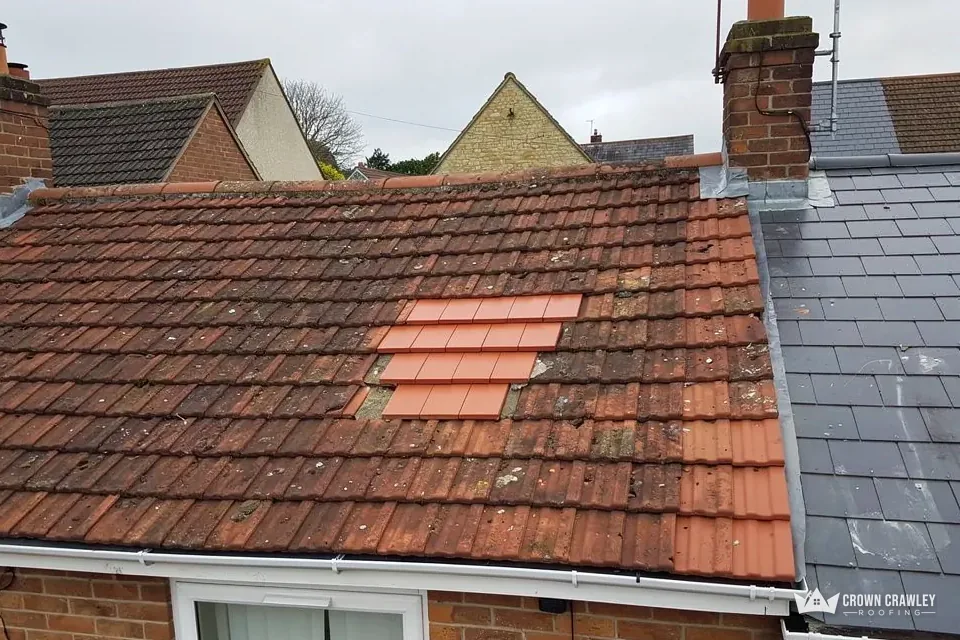
Once the entry point is confirmed, the repair follows from it. A cracked tile is replaced, a lifted flashing is refixed or renewed, a blocked valley is cleared and relined, a split membrane is patched or recoated. The roofer should also deal with damage the leak has caused: wet insulation, rotted batten or a ceiling that has absorbed water. Fixing the entry without checking the timber beneath leaves the next problem waiting.
What should you ask for?
Every job we do starts with a survey, and we share photos taken on your roof, so you see the same defects we do. Ask any roofer to show you the opening, the damage around it and the repair, and to describe what was done in writing. A written total price for the permanent repair should follow the survey. If the roof cannot be fixed at once, a temporary cover is the sensible first step, and we cover that in our answer on emergency roof tarpaulins.
Is it a repair or something bigger?
One entry point on an otherwise sound roof is a repair. Several openings across a slope, tired battens or a covering that is slipping everywhere is a different conversation, and your roofer should explain why a patch will not hold. If water is coming through now, put a bucket under it, move belongings clear and keep away from any bulging ceiling. For the full range of urgent work, see our emergency and general roof repairs page, then call 01293 974253 or send photos of the stain and the loft by WhatsApp and we will plan the visit around what they show.
Part of our Emergency & General Roof Repairs in Crawley
Leak-tracing questions
Can I find a roof leak myself with a garden hose?
You can try, but only from the ground or a safe loft position. Wet one small area at a time from the bottom up, with a helper watching inside. Never climb onto a wet or tiled roof to do it. If you find nothing, a roofer has the access and experience to look at the places you cannot reach.
Why does a leak only appear when the wind blows?
Wind drives rain sideways and upward under tiles, ridge caps and flashings that would shed ordinary rain. A leak that shows only in a gale points to a lifted or loose covering on the side facing the weather, or a gap in a verge or ridge. A hose test may miss it, so photographs taken during the storm help.
Can a roof leak stop on its own?
The visible drip can, once the rain stops and the water has drained, but the opening is still there. Wet insulation and timber may keep releasing moisture for days. Treat a stain that dries as a warning rather than a cure, and have the roof inspected before the next storm makes it worse.