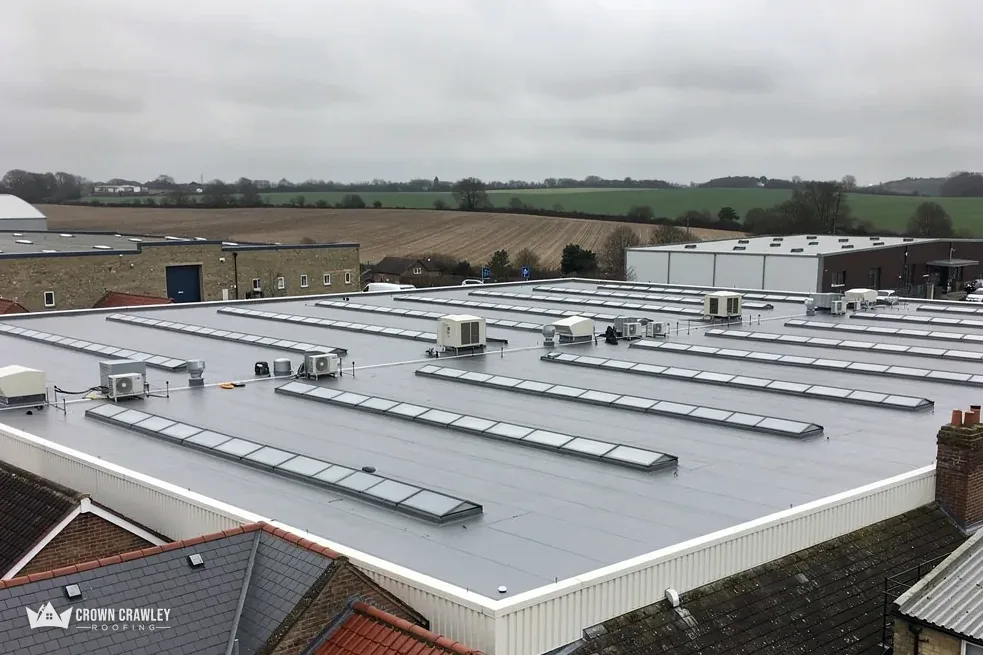
Picture a flat roof as black felt or a coat of something poured on. Single-ply is a different idea. A manufacturer makes a flexible waterproof sheet in a factory, where thickness and quality can be controlled, and the roofer unrolls it over the insulation and joins the sheets together. One layer does the waterproofing, which is where the name comes from. On warehouses, retail units and offices it has become a familiar sight, because wide rolls cover big areas quickly and the seams are few.
Choosing one is less simple than the brochures suggest. The three main families behave differently under heat, behave differently at the joints, and suit different buildings. How the sheet is held down matters as much as the sheet itself. This guide explains each family in plain terms, the fixing methods, why the fall of the roof still matters, what a realistic lifespan looks like, and what to ask before you accept a warranty certificate.
What makes a membrane single-ply
The defining feature is that the waterproofing is a single sheet, which is rolled out and joined, rather than layers of felt stuck together or a liquid that cures into a skin. Everything beneath it, the deck, the vapour control layer and the insulation, forms the rest of the roof build-up, and that part is not single-ply at all. The sheet is only as good as the roof it sits on. A leak that looks like a membrane failure is often a wet deck, a crushed insulation board or a blocked outlet, so a proper survey looks below the surface as well as at it.
Where does single-ply suit best?
It tends to suit large, simple roof areas with few interruptions, and it copes with re-roofing over existing layers when the build-up has been checked. A roof crowded with plant, rooflights and cable routes will need many detail pieces, and the work is then as much about careful hand finishing as the sheet itself. Our wider commercial roofing page shows how single-ply fits next to other coverings on commercial buildings.
What are the parts of the system?
A complete system includes the vapour control layer under the insulation, the insulation boards, the membrane, and accessories such as pre-formed corners, outlets, edge trims and sealants. Mixing parts from different makers can leave the roof without a warranty, so ask who supplied each component. The membrane is the visible part, but the weak points sit at the edges, corners and penetrations where the accessories do their work.
Because the sheet is thin, the substrate must be clean and sound. Sharp edges, loose debris or leftover fixings under the sheet can wear through it over time. Where old layers stay in place, a separation layer or extra board protects the new sheet from whatever sits beneath, and the maker's rules say which is needed.
The three main families
Three plastics and rubbers dominate single-ply on commercial roofs. Each is a different material, so the way it is joined and the way it ages differ.
Polyvinyl chloride (PVC)
PVC sheets are usually reinforced with a fabric or glass scrim and joined by hot-air welding, which fuses the overlap into one piece. A welded seam can be checked along its length with a probe, so the installer can show you the result. The mix of additives differs between makers, so the manufacturer's data sheet matters more than the family name.
Thermoplastic polyolefin
Thermoplastic polyolefin is also welded with hot air, but the material is different from PVC, and products from different makers vary more than the shared name suggests. Ask for the maker's data on weathering, fire performance and weld strength rather than relying on the family name.
Ethylene propylene diene monomer (EPDM)
EPDM is a synthetic rubber sheet. It is joined with adhesive or tape rather than heat, and large sheets can be supplied so that a roof has few seams. GreenSpec lists a 20 to 30 year expected service life for EPDM. Our answer on EPDM on a commercial roof looks at it in more depth.
None of these is simply better, and a salesperson who says otherwise has not seen your roof. The right choice depends on the roof shape, the amount of foot traffic, the fire rules for the building and what the manufacturer will warrant over your particular build-up. Ask for the data sheets of the sheet being offered and read them for thickness, reinforcement, fire classification and the temperature range for welding or gluing.
How the sheet is held down
Whichever family you pick, the sheet has to stay put in wind. There are three ways to do that, and a roof can use a mix of them.
Mechanically fixed
Fasteners with large washers or plates are driven through the sheet's edge or through special bars into the deck, then covered by the next sheet. The fixings are spaced to the manufacturer's wind-load calculation, which depends on the building's height and its edge zones. The deck must be strong enough to hold the fixings, so a survey of the deck comes first. Corners and perimeters need more fixings than the middle of the roof, because wind pulls hardest there. A pull-out test on a sample of fixings before the order is placed shows whether the deck will hold them.
Fully adhered
The membrane is glued to the insulation or deck with adhesive across its whole area. This gives a smooth finish with no fasteners through the sheet, and it suits roofs where wind uplift is high or where a mechanical fixing pattern is awkward. The surface must be clean and dry, and the weather on the day has to suit the adhesive. A cold, damp morning can stop the work, so build some slack into the programme when you plan a date.
Ballasted
Loose-laid sheets are held down by weight, usually stone or paving laid on top. Ballast needs a structure that can carry the load, and the roof must be checked by an engineer first. It also hides the membrane, which makes spotting damage harder.
The fixings pattern, the sheet width and the seam type all belong in the written specification you receive. If a quote simply says single-ply membrane, with nothing about how it is held down, ask for more detail before you compare it with another.
Falls, seams and the places leaks start
A membrane is waterproof, but a roof can still leak. The common causes are poor drainage, weak details and damage.
Why does the fall still matter?
Single-ply sheets do not make a flat roof drain by themselves. BS 6229:2025 covers flat or curved roofs with a pitch no greater than 10 degrees and keeps a minimum finished fall of 1:80 for the general roof area and internal gutters. IKO, working from the 2018 edition, advises designing for 1:40, which leaves room for the finished roof to reach the minimum. Standing water is not always a leak, but it ages seams, collects dirt and adds weight. On a large roof, the survey should mark where water sits after rain, so that any levelling or extra outlets are priced in from the start.
Where do leaks start?
Rarely across the open sheet. Look at the upstands, the short upturned edges where the roof meets a wall, and then the corners, the outlets, the plant bases and the rooflight kerbs. Every one of these is cut and formed by hand on the day. A good installer test-checks the welded seams, keeps detail drawings and photographs the work before covering anything up. Ask to see those records at handover; they are the best evidence of how the roof was made.
What damages a membrane afterwards?
Foot traffic from maintenance staff is the usual culprit: dropped tools, dragged ladders and sharp-edged plant bases. Walkways of protective tiles along service routes cost little and save the sheet. Solar panels and new plant installed later also need a protected route and proper fixings. Our answer on fire-rated flat roof membranes covers the fire side of the specification.
Life expectancy and what a warranty means
Owners often ask for a lifespan. The straight answer is a range that depends on the material, the quality of the laying and how the roof is treated afterwards. For EPDM the GreenSpec range is 20 to 30 years. For polyvinyl chloride and thermoplastic polyolefin, rely on the maker's data and ask what evidence supports the figure.
Is a warranty the same as a lifespan?
No. A warranty is a promise about who pays if something specified goes wrong in a set period. The paper makes no promise that the roof lasts that long, and it often excludes damage by other trades, ponding water, lack of maintenance and anything outside the maker's system. A certificate that names a long period may still cover only a narrow list of failures.
Whose promise is it?
There may be a product warranty from the membrane maker, a system warranty covering the whole build-up if the maker has approved the installer and inspected the roof, and workmanship cover from the contractor. Read each one, check what voids it, and keep copies with the building file. Our guide to commercial flat roof warranties reads that small print in detail.
What about maintenance?
Warranties often depend on keeping the roof clear. Clearing outlets and gutters, checking after storms and logging every visit by other trades all help to protect the cover. Write the dates down: the log is useful evidence if a claim is ever needed. A roof that has been left unchecked for years gives the maker an easy reason to refuse.
Cost drivers and what helps a survey
A commercial price per square metre means little until someone has seen the roof. For a loose sense of scale, Checkatrade's rubber roofing guide, in its September 2026 table, puts EPDM flat roofing at £80 to £100 per m², with an average of £90, against £50 to £80 per m² for felt. That is a national guide for flat roofs generally, and a large commercial roof will be priced on its own merits. VAT at 20% may need adding.
What moves the price?
The area, the height and the access come first, then the state of the existing roof, the insulation thickness, the number of details and the fixing method. If old layers must come off before the new sheet goes down, that adds work, and the waste type matters. A tidy handover includes the as-built drawings, the product data and the test records, all kept together. Roofs with asbestos cement beneath, which our guide to overcladding an asbestos cement roof explains, follow different rules.
What should you send us?
Ground-level photos and pictures of any marks inside help most, along with the building address, the roof's approximate age and any existing warranty papers. After the survey we give one written total price, and we explain what the survey found on your roof with photos. Ask for the specification in writing too, naming the membrane, the thickness and the fixing method, so the figure can be tied to a stated product.
Part of our Commercial Roofing in Crawley & Gatwick
Single-ply questions answered
Can single-ply go over an existing flat roof?
Sometimes. The old layers must be dry, firmly attached and strong enough to carry the new build-up, and a survey with moisture checks decides it. Wet insulation under a new sheet only hides a problem. The maker's rules for overlaying also affect whether a warranty is offered.
Do welded seams ever fail?
They can, usually through poor technique, dirt in the weld or damage after laying. That is why seams are probed and tested on site, and why a contractor should keep records of them. Ask how the seams will be checked, and whether you will receive the results with the handover paperwork.
Is a longer warranty always better?
Not necessarily. Read what the certificate covers, what voids it and who stands behind it if the contractor closes. A shorter term with wide scope and clear wording may protect you better than a longer term with narrow cover. Ask for the full document before you sign.