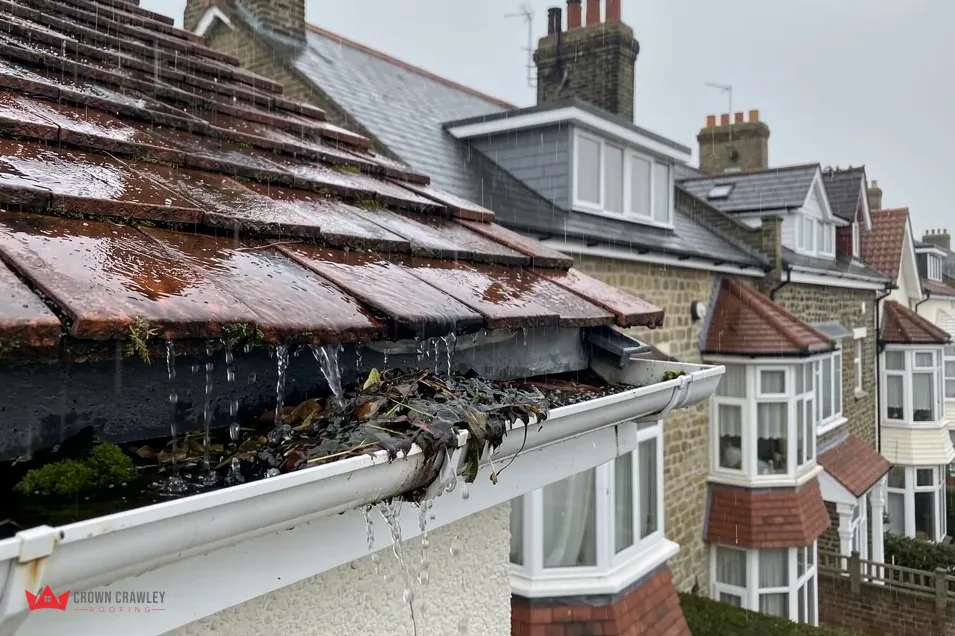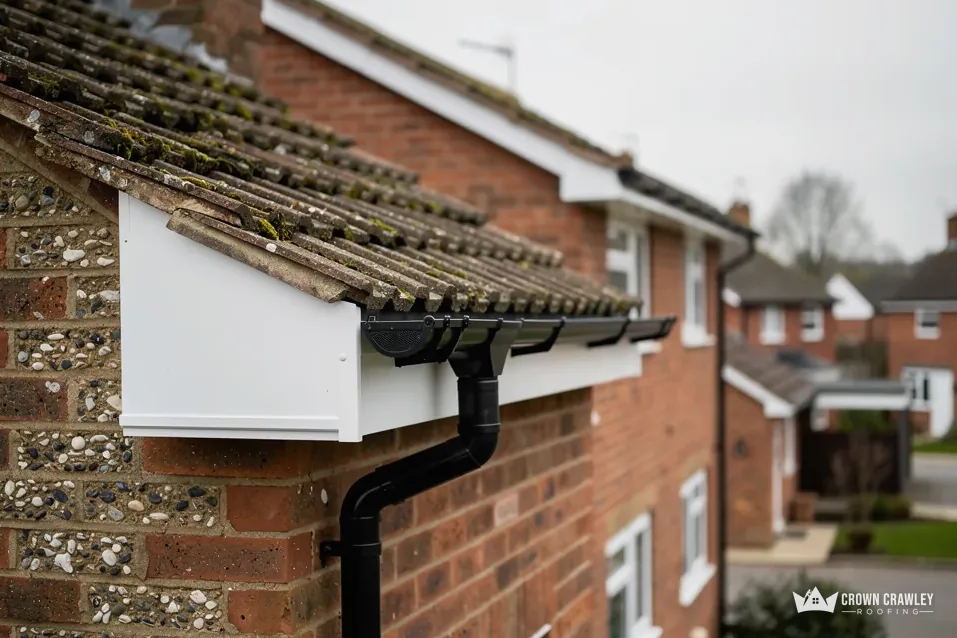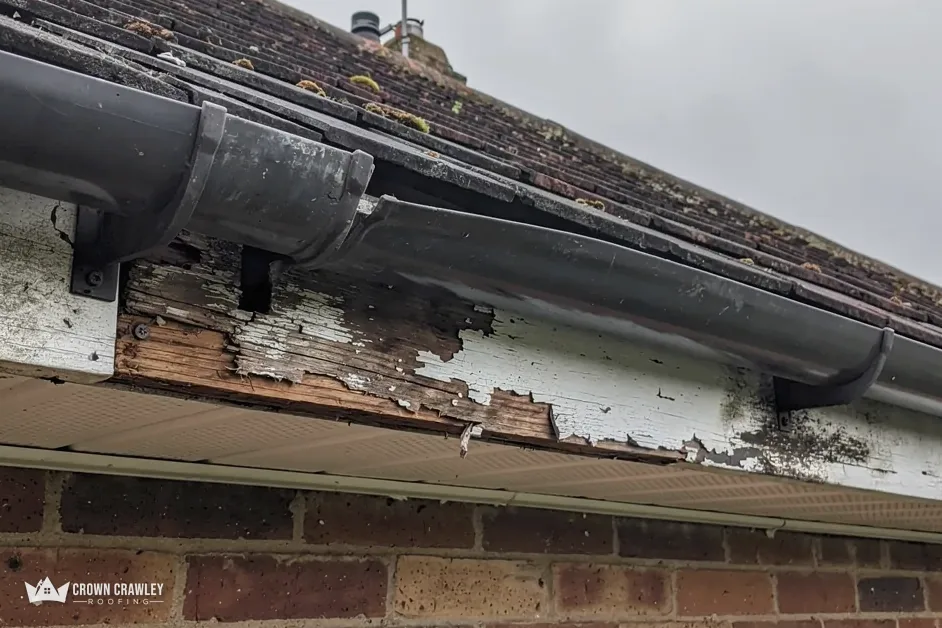
Gutters fail from neglect far more often than from age. Leaves, moss, roof grit and the odd tennis ball collect in the channel, water stops flowing and starts overflowing, and a perfectly sound gutter ends up leaving a green stripe down the wall. The same gutter, cleared twice a year and checked over, can go on doing its job for a very long time. That is the whole case for gutter maintenance, and it costs far less than putting right a wall that has been wet for several winters.
This post covers the gutter only: the channel, the joints, the brackets and the downpipes. It does not cover the fascia boards or soffits behind and beneath it, which have their own care routine in a separate post. We set out what to do, in what order, what you can sensibly do from the ground, and the point at which a ladder job should go to someone with proper access. It replaces an older post that wandered into advice better suited to American houses, so everything here is aimed at British guttering.
A twice-yearly routine that works
Pick two fixed points in the year. Late autumn, once the trees nearby have dropped most of their leaves, is the first. Late spring, after seeds, catkins and blossom have fallen, is the second. Add an extra look after any big storm, and after any spell of heavy rain if you have seen water spilling over.
What does a full check involve?
Work through it in the same order every time, so nothing gets skipped. Start with a walk round the house on the ground, looking up. Then clear the channel along each run. Next check each joint and each stop end for drips or cracks. Look at the brackets and the line of the gutter. Finish at the downpipes and the gully, running water through to confirm it drains. Write the date and what you found on a note kept somewhere sensible, such as the back of a cupboard door. After a couple of years that note tells you which run fills first and which joint always weeps.
What will you need?
Very little. A pair of thick gloves, a small plastic trowel or scoop, a bucket or bag, a garden hose, a stiff brush and, if you use a ladder at all, a ladder stand-off that rests against the wall and not on the gutter. A gutter is not designed to carry your weight, and plastic runs crack when a ladder leans on them. Wear eye protection if you are working above head height, because dry debris can fall back into your face.
Make the check part of something else you do twice a year, such as changing the clocks. A habit tied to a date is easier to keep than a vague plan to look at the gutters when you get round to it.
Clearing the channel without hurting yourself
This is the job a careful homeowner can do, and also the one that sends people to casualty. Ladder falls are a real hazard in home maintenance, so the first question is whether you should be up there at all. If the gutter is above the first floor, if the ground is sloping or soft, or if you cannot reach it with the ladder properly footed and tied, the answer is to call a professional with the right access gear.
How do you clear it from a ladder?
Position the ladder on firm, level ground, at a safe angle, with a second person footing it and the stand-off against the wall. Keep your belt buckle between the rails and never overreach. Scoop the debris into a bucket hung on the ladder rather than dropping it down. Start at the end farthest from the outlet and work towards it. Soft, wet silt comes out with a trowel. Hard clumps of moss lift out in a mat once you loosen the edges.
Is it safe to use a pressure washer?
We would not. A high-pressure jet drives grit under the joint seals, can strip the finish from the channel and fires dirty water at the wall behind. A hose set to a firm flow does the job. Once the bulk of the debris is out, flush the channel with the hose and watch where the water goes. It should run steadily to the outlet and out of the downpipe. If it pools in a section that stays full after the flow stops, that stretch has lost its fall, which we come to below.
Whatever you take out, do not tip it down the downpipe. Bag it, and put it with garden waste or compost. Moss and leaves that go down the pipe can lodge at the first bend, and you will have created a second job.
Joints, seals and small cracks
Most gutter leaks start at a joint. Each length of gutter is joined to the next with a clip and a rubber seal or a bead of sealant, and over time those seals dry, shrink or get pushed out. The first sign is a thin dribble at the joint in rain, then a green or black streak on the wall below.
How do you find a leaking joint?
The easy way is to pour a bucket of water into the channel on a dry day and watch the joints from the ground. A joint that weeps will show a line of drips within a few seconds. Mark the spots with a note, not with chalk on the wall. You can also look for a rim of old sealant that has cracked, a visible gap at the join or a rust bloom if the gutter is metal.
What can you fix yourself?
A weeping joint on a plastic run can often be dried, cleaned and resealed with a sealant made for guttering, applied on the inside along the seam. Small hairline cracks in plastic can be treated the same way as a stopgap. These are short-term repairs. If the same joint reopens each year, the clip has loosened or the gutter has moved, and the sealant is hiding the real fault. In that case the section needs refixing or the length replaced. Our answer on a leaking gutter joint sets out how that decision usually goes.
Cast iron, metal and older concrete gutters need a different approach, because rust and cracked sections do not respond to a bead of sealant. If you can see flaking, holes or a joint that has dropped, photograph it and ask for a survey. Sealant on a failing metal gutter only delays the day the water finds its way out.
Brackets, fall and sagging runs
A gutter holds water, which is heavy, and it holds it on brackets spaced along the run. When those brackets loosen, bend or rot out of the fixing, the channel dips between them. A dip anywhere means the water stops flowing and sits.
What should the gutter look like?
From a short distance back, a healthy run should look straight and should fall gently towards the outlet. Brett Martin's installation guidance puts the fall at 1mm for every 600mm of length, a slope you can barely see. A common check is to look along the underside against the line of the fascia; the gap should close in a smooth, even way towards the downpipe, with no hump and no bowl.
What causes a gutter to sag?
Weight is the usual culprit. A channel that has stayed full of wet debris puts constant load on the brackets, and a run that has carried snow or ice may have been pulled forward. Brackets that are too widely spaced or fixed into soft timber will also let go. If a bird has built in the channel, leave it alone until the young have gone: deliberately damaging a nest that is occupied or under construction can be a criminal offence under the Wildlife and Countryside Act 1981.
Adding a bracket in the dipped section and resetting the fall often cures a sag in a plastic run. Refixing does need access to sound timber behind, so if a screw turns without biting or the board behind is soft, stop. That is a fascia problem, and the work widens beyond the gutter. The answer on a sagging gutter fix gives more detail.
Do not try to force a sagging section back up by bending it. Plastic that has been deformed rarely sits right again, and the joints either side may be loosened by the effort.
Downpipes, gullies and when to call us
A clear channel is wasted if the downpipe is blocked. The pipe is narrower than the gutter, with bends that trap leaves, and the gully at the bottom collects silt.
How do you clear a downpipe?
Start at the bottom. Lift the gully grid and clear the silt and leaves. Then run a hose into the outlet at the top and watch the base. A strong, steady flow means the pipe is clear. A trickle, or water backing up in the gutter, means a blockage. A flexible rod or a length of garden cane will often push a soft blockage through, working from the top down. A hard blockage, such as a ball or a nest, may need the pipe taken apart at a joint. Our page on a blocked downpipe covers that case.
Are gutter guards worth fitting?
They reduce how much comes in, but they do not remove the need to look. Fine debris, seed and moss can still build up on or under a guard, and some designs make the channel harder to inspect. Weigh the trade-off before you buy.
When should you hand it over?
Call a roofer when the gutter is out of reach of a safe ladder, when joints leak along the whole run, when the metal is rusting through, when the board behind the brackets is soft, or when the same fault returns after you have fixed it. Our gutters, soffits and fascias team begins every job with a survey, shows you photos of your own gutters and then gives one written price. To save time, send us a photo of the sagging section and the wall below it, with the length of the run, and say whether a ladder can stand safely at that point.
Part of our Gutters, Soffits & Fascias in Crawley
Gutter care queries
Do gutters need cleaning if no leaves fall nearby?
Yes, though less often. Roof grit, moss from the tiles, seeds and windblown dust all end up in the channel, and wet silt can grow plants. A look in late autumn and again in late spring still shows whether water is moving freely, and costs you nothing but a few minutes from the ground.
Can I seal a leaking gutter joint with ordinary silicone?
Use a sealant made for guttering and apply it to a clean, dry seam. Ordinary bathroom silicone often peels away in wet weather. Treat any sealing as a stopgap, because a joint that keeps reopening usually means a loose clip or a moved length that needs refixing rather than more sealant.
How do I know if my gutter has lost its fall?
Run a hose into the channel and watch. Water that pools and stays after the flow stops marks a low spot. A visible dip between brackets points the same way. Send us a photo along the run and mark where the water sits, and we will say whether a bracket or a new length is the likely fix.