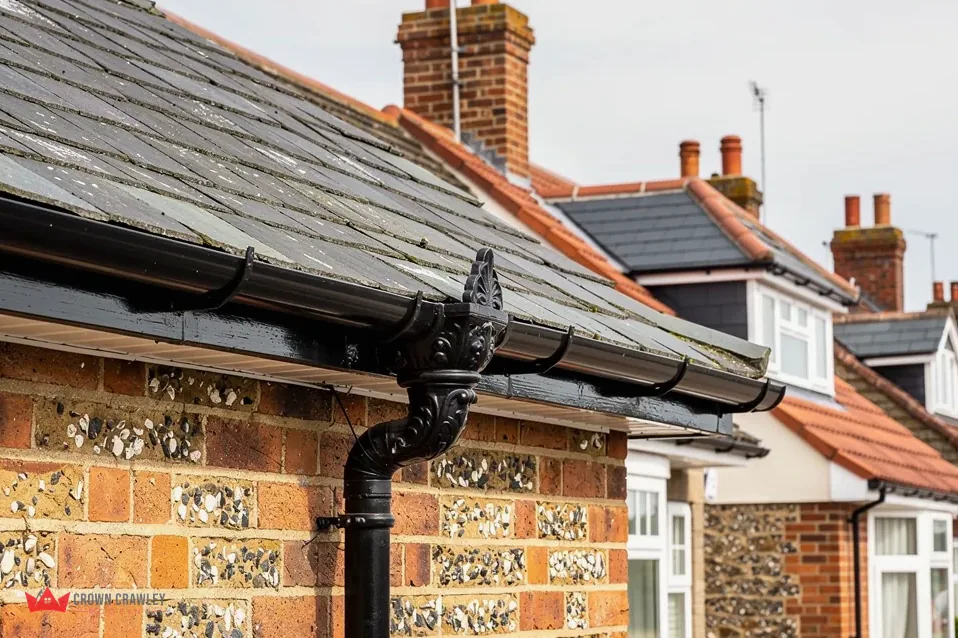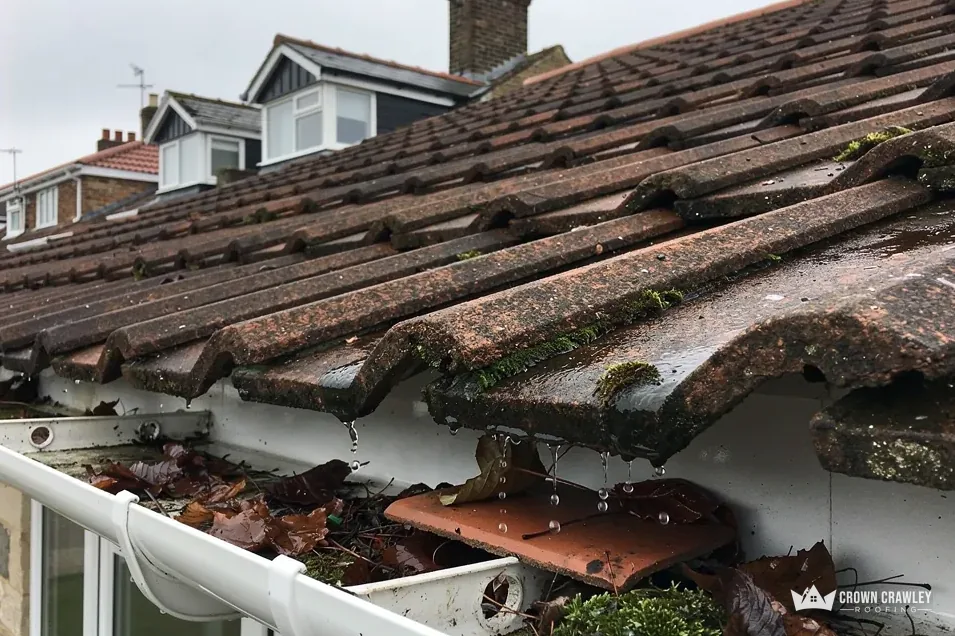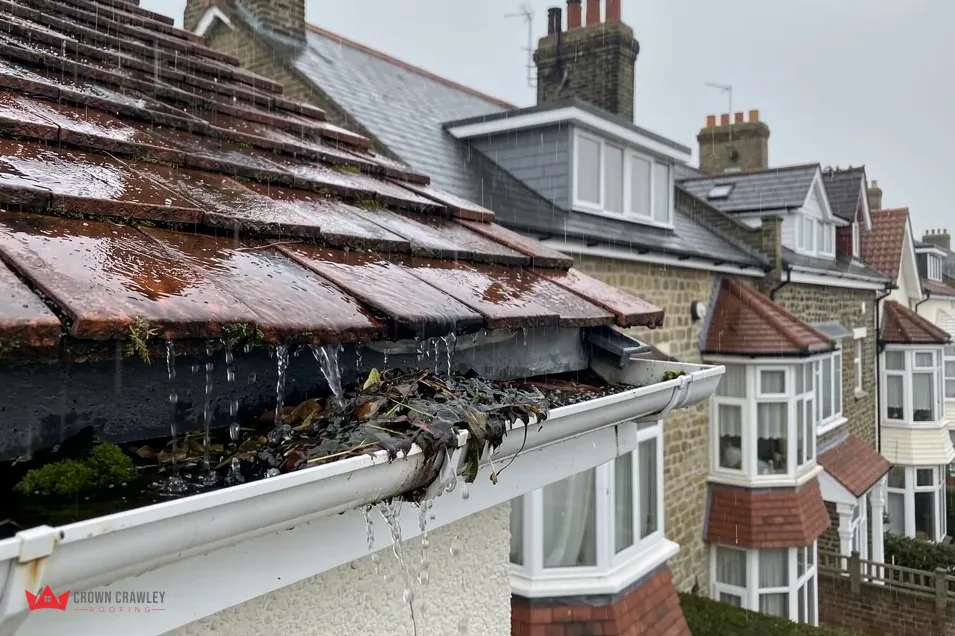
Look up at the edge of any house and you will see two strips of board. The fascia is the vertical one at the end of the rafters, the board your gutter is screwed to. The soffit is the flat panel tucked under the overhang, shutting off the space where the wall meets the fascia. Together, and with the bargeboard that runs up the gable end, they make up the roofline. They keep rain off the rafter ends, give the gutter something solid to hang from, and, with vents in the soffit, let the roof space breathe.
Because they sit so close to the weather, the material you pick for them decides how often you will be up a ladder with a paint brush, how the house looks from the street, and what the next owner inherits. Four choices are on offer for a typical replacement: uPVC, timber, aluminium and composite. This post sets out what each does well and where each lets you down, with the typical UK costs we can source, and it flags the one thing worth checking before any old board is touched: whether it contains asbestos.
What the roofline boards actually do
It helps to know the job before you choose the board. A fascia is not decoration. It closes the end of the roof structure, carries the gutter, and gives the bottom row of tiles and the edge of the underlay something to finish against. A soffit protects the underside of the overhang from rain blown upwards and from birds, wasps and weather getting into the roof space.
Why do soffits have vents?
A roof space needs air moving through it. Moist air leaking up from the rooms below turns to water on cold timber, so a continuous slot or a row of vents at the eaves gives it a way out. Marley's guidance, based on BS 5250, asks for a 25 mm continuous opening at the eaves on roofs pitched at 15 degrees or less, and 10 mm on anything steeper, when the roof is cold and the underlay does not breathe. Whatever material you pick, the soffit has to keep that opening clear. A solid board with no ventilation can set up condensation in the loft that rots the timbers it was meant to protect.
What does the choice of material change?
Weight, upkeep, how well it stands up to damp and sun, how the joints are made, and how it looks. It also changes what you pay now compared with what you pay over the next two decades. A cheap board that needs repainting every few years can cost more than a dearer one that is left alone. A material that suits a 1960s estate house will not necessarily suit a Victorian terrace with a timber roofline.
uPVC: low upkeep and the usual replacement
Unplasticised polyvinyl chloride, written uPVC, is the white or coloured plastic board you see on the roofline of houses of every age. It is made as hollow-section fascia, flat soffit and ventilated soffit panels, with matching trims and corners.
What does uPVC do well?
It never needs painting, it will not rot, and it can be wiped clean with water and a mild cleaner. The boards weigh little, which makes fitting quick and spares the rafter ends. It can be bought in white, black, grey, brown and woodgrain finishes, and the vented soffit is available off the shelf. For most roofline replacements it is the starting point, and it usually costs least of the four.
What are its limits?
White plastic can yellow and take on a dirty film, particularly on a north face. Cheap boards can bow in strong sun, and a poorly fixed length can crack or pull out at the joint. Plastic cannot be repainted to follow a heritage colour scheme, and it looks wrong on some period houses where the original profile was a deep timber board with a moulding. It also sits over the old timber, so if that timber is rotten and no one checks, the rot continues beneath. As to lifespan, a retailer's guide puts uPVC fascia at between 20 and 40 years. That seller has an interest in the answer, and the range depends on exposure and installation. Our answer on how long uPVC fascias last looks at it from an installer's side, and our gutters, soffits and fascias service covers the whole roofline.
Timber: the traditional board that needs paint
Timber was the standard roofline material until plastic took over, and it is still made and fitted today, in softwood, hardwood and treated or primed grades. On older houses it carries the profile, the depth and the moulded edge that give the roofline its character.
Why choose timber?
Because it looks right on the right house. A period property, a listed building or a street with a uniform look often needs boards that match what was there, and timber can be cut to any profile and painted any colour. It is easy to work with on site, simple to patch, and can be repaired in sections. A well-primed, well-painted board that is kept dry at the back can last for a long time.
What does timber demand?
Care. Paint on a fascia must be renewed before it fails, and the end grain and underside, which take the most water, need the most attention. Rot starts where a gutter has leaked behind the board, where a joint lets water in, or where the board stays damp. A soft board that a screwdriver sinks into has gone. Our guide to the signs of a rotten fascia board covers what to look for. Timber also costs more to keep up than plastic, since every few years it needs a coat and the access to apply it. In a conservation area or on a listed house, ask the council's planning team before swapping timber for another material.
Aluminium: slim, tough and coated
Aluminium roofline is made from sheet that is folded, bent and then powder-coated or foil-wrapped, and it appears as cladding over existing timber or as a complete replacement board. It is lighter than most alternatives and comes in a wide choice of finishes.
What are the benefits?
Aluminium does not rot or warp, its factory finish holds colour well, and the sections are thin enough to give a crisp, modern look. It suits contemporary houses, extensions and flat roof edges, where a clean line is the aim. Coated trims also make a neat finish at the edge of a flat roof, so they are a natural pairing with a new membrane.
What are the drawbacks?
It dents, so a ladder, a ball or a careless knock leaves a mark that will not come out, and the coating can chip. It is a metal, so joints and corners need to be made tidily and sealed, and the cost is higher than uPVC. Colour matching a repair is harder than with paint. If you wrap an existing timber fascia in aluminium, the board underneath must be sound and dry, since cladding hides rot instead of removing it. Ask the fitter to open up a section and show you the wood before closing it in. This is also a job where the written price should say which finish and which thickness are included, so that you know what you are being quoted for.
Does it need ventilation like the others?
Yes. Aluminium soffits come in vented versions too, and the same rule applies: the gap that lets the roof space breathe must stay open once the boards are on.
Composite and fibre cement boards
The fourth option is a group rather than a single material. Composite boards are made from mixed ingredients, often a plastic combined with a filler or a wood-based product, formed to look like painted timber. Fibre cement boards are a cement and fibre mix, cut and pressed to shape, and are sold for fascias, soffits and bargeboards.
Where do they fit?
They sit between timber and plastic. Makers pitch them to people who want a wood-like look with less painting, or a stable, rot-proof board with some weight to it. Composite can reproduce a moulded profile that hollow plastic cannot. Fibre cement is stiff and fire-resistant, and manufacturers describe it as resistant to insects and rot. Both are made in fewer colours and profiles than uPVC, they can be heavier to fit, and they are dearer.
What should you ask before choosing one?
Ask for the maker's own life figures and warranty terms in writing, and remember that a warranty is not the same as a lifespan. Lifespan claims for these two vary by maker, so treat any round number from a salesperson with care. Ask how the boards are cut, sealed and fixed, whether the cut edges need treating, and whether they can be painted when you want a change. Ask too about the supply, because a profile that is discontinued in ten years will make repairs difficult. A good fitter will be glad to tell you the downsides of what they propose.
Before you phone round, photograph each elevation of the roofline from the ground, note which boards look soft, stained or loose, and measure the front of the house if you can. Those few details let a survey go straight to what matters on your boards.
Cost, old boards and what is living in them
Costs below are national typical figures, not Crown prices. In Checkatrade's fascia, soffit and guttering guide, updated December 2025 with its table dated September 2026, replacement runs at around £150 per linear metre, with capping at £85 per linear metre, and a small semi-detached house averages £2,750. Those include the moving parts of a job: access, the amount of board, the number of corners and whether gutters come off. The price that counts is the one in writing after a survey, and you should confirm that VAT and scaffold are counted within it. Our answers on fascia capping versus replacement and fascia and soffit replacement cost explain how the sums are built.
Could old soffit boards contain asbestos?
Possibly. HSE includes external soffits in its list of locations for asbestos insulating board, and a board that contains it looks much like one that does not. HSE's starting assumption for anything built or refurbished before 2000 is that asbestos is present. Leave a suspect board alone: no drilling, snapping or scrubbing. Insulating board removal is mostly licensed work, which rules out a weekend pull-down. Our answer on asbestos soffit boards explains the next step.
What about birds and bats?
Roof edges are where birds nest and bats roost. Both carry legal protection, and the details are in our answer on soffit vents, birds and bats. If you notice droppings, scratching or a nest at the eaves, stop and take advice before a single board comes off.
Part of our Gutters, Soffits & Fascias in Crawley
Fascia and soffit material questions
Which material costs least to look after?
Of the four, uPVC and aluminium ask the least, since neither needs repainting, while timber asks the most. Composite and fibre cement sit between them. The lowest price to buy is not always the lowest to keep, so compare the paint and upkeep you would otherwise face.
Can new boards be fitted over the old ones?
Sometimes, as capping or cladding, if the timber underneath is sound and dry. Rotten or loose boards must come off first, or the problem carries on out of sight. Ask the fitter to open a section and show you what is behind it before agreeing to cover it.
Do soffits and fascias need building control approval?
Like-for-like replacement of boards is normally maintenance rather than a project that needs approval. Planning rules may apply on a listed building or in a conservation area, so ask the council's planning team. Ask your building control body if you are changing the roof structure or the eaves ventilation.